The Clothiers’ Guild
Tailors, drapers, glovers, haberdashers, dyers, weavers and furriers of Hârn
Version 1.0 · November 2026 · the current edition is kept here, at 4hmlb.com/library/clothiers-guild.html · send word to vaidenon@4hmlb.com
“A man may lie with his tongue, but his coat tells the truth about his purse. I have spent more hours than I care to own in the halls of the clothiers of Tashal, asking questions they were too busy to answer. What follows is what I learned from them and from the old books, with the Fellowship’s own additions marked where the books fall silent.”
— Vaidenon of Hustan, Warden of the Inkhorn Fellowship, Tashal, Navek 720 TR
Clothiers belong to one of the largest guilds on Hârn, though I have yet to meet a syndic of any other guild who will admit it. Most Hârnians make their own garments, but the wealthy middle class and the nobility count a clothier’s work among their marks of standing, and some noble households keep bonded master clothiers in their employ. In the towns, about one guildsman in sixteen is a clothier.
A master clothier knows the arts of the tailor, the glover, the draper and the haberdasher, though many masters keep to one. Other specialities are those of the dyer, the weaver and the furrier. A thriving establishment employs dozens of journeymen, apprentices and bonded masters, and many clothiers also profit, more than they care to say, from a web of unguilded spinners and weavers in the town or on the manors nearby.
The guild’s monopoly covers the making and sale of clothing and cloth goods. Protective garments of cloth and quilt are not theirs: those are the work of the armourers of the Weaponcrafters’ Guild, who buy their base garments, buckram and thread from clothiers. Leather is ground the clothiers share, not always peaceably, with the hideworkers.
Organisation of the Guild
The Clothiers’ Guild follows the pattern of most Hârnic guilds, with apprentices, journeymen and masters gathered in chapters. A large town such as Tashal, Cherafir, Coranan, Shiran, Golotha, Aleath or Thay supports a chapter and guildhall of its own; smaller towns share a chapter that may cover a shire or more. The syndics of the Tashal chapter have been patient with my questions, and I thank them.
Apprentices
A clothier’s apprenticeship lasts about six years. The apprentice sweeps, sorts wool, cards and combs, winds thread, bastes seams and runs errands; long hours and frequent beatings are thought normal, and I have heard no master call them otherwise. Most apprentices are the children of masters, exchanged between shops in neighbouring towns. Other places are sold.
Journeymen
A journeyman earns between a third and two thirds of a bonded master’s wage, with room and board, and is expected to travel. A journeyman tailor who has worked in Coranan, Cherafir and Tashal knows the cut of three courts, and that knowledge is prized. After three to five years he may apply to any chapter’s syndics for promotion, bearing letters from three masters he has served.
Masters
Candidates for master sit an oral examination and present a masterpiece: a complete set of clothes for a man or woman of rank, cut, sewn and finished by the candidate alone, from shirt to mantle. (Inkhorn) Passing is not the end of it. A new master must still inherit or buy a franchise, which costs two to ten years of a bonded master’s income, 1,440 to 7,200d for a clothier, besides the customary bribes, which no syndic has ever described to me as such. Masters pay a tenth of their income as dues.
The syndics publish fair-price guidelines. A master who sells fine work too cheaply, or poor work too dearly, will receive a visit, and not a social one; fines follow, and in the end the franchise may be revoked.
Making Cloth and Clothing
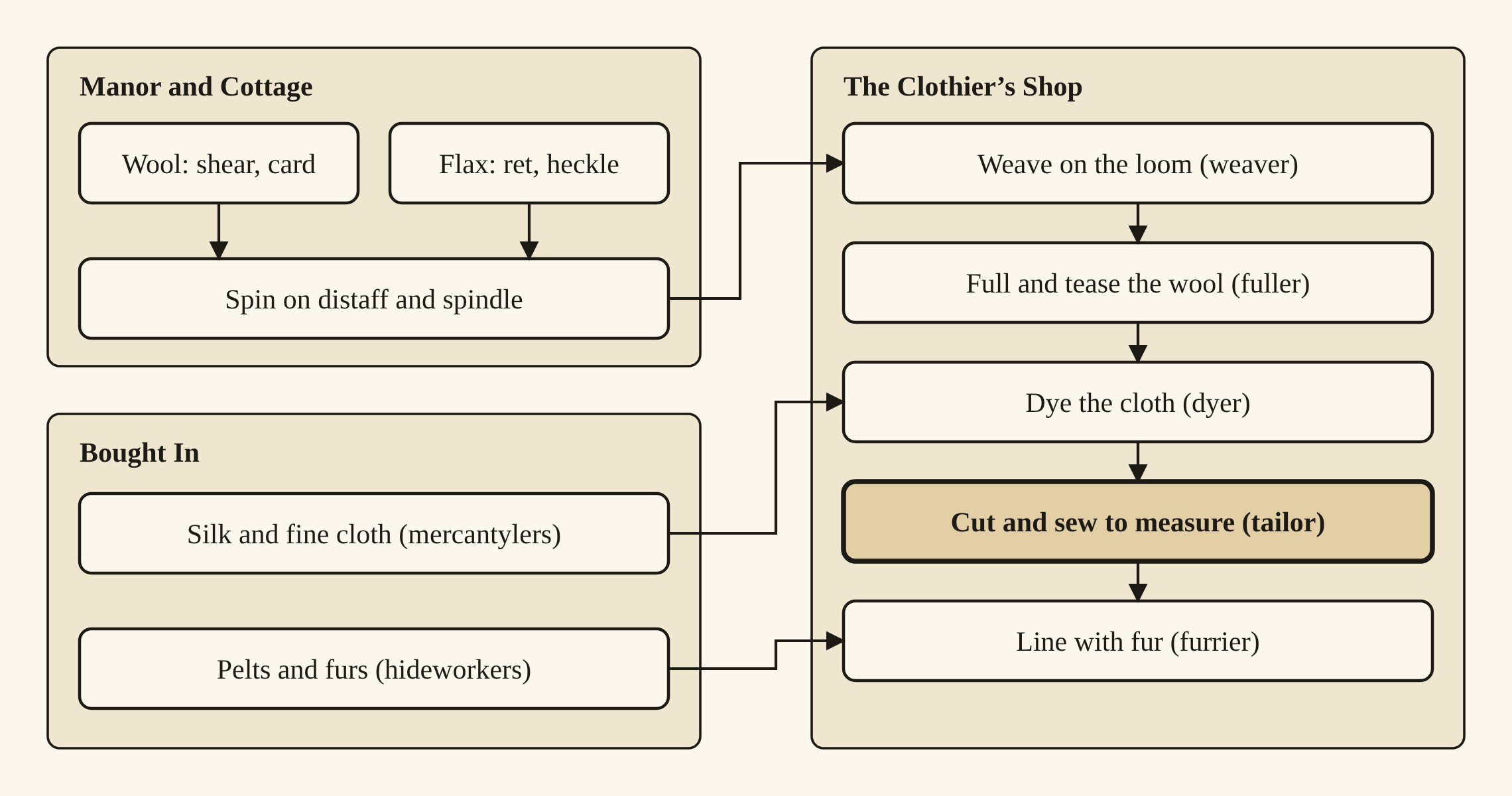
Most of the work that turns a fleece into cloth is done outside the guild. Shearing, washing, carding and combing wool, and retting, scutching and heckling flax, are manor work. Spinning is women’s work at home, on distaff and spindle; my mother spun every evening of my childhood in Hustan. In Menglana the clansmen’s wives spin and weave the light, warm wool that Thegholm’s clothiers export. The guild’s own work runs from the loom to the needle.
Weaving
Weavers are clothiers by speciality. Many masters put out spinning and weaving to unguilded cottagers in the town or on nearby manors, and buy back the yarn and cloth. Cloth sold in a town market carries the mark of a guild weaver, and a stallholder who stitches the mark himself had better hope the syndics never look closely. (Inkhorn)
Fulling
Woven wool is beaten in water and fuller’s earth until it shrinks and thickens, then stretched on tenters and raised with teasels. At Chyrefal in Melderyn a master clothier has made a fulling process her own, and her wool comes out exceptionally soft; her gowns are sought by ladies throughout Hârn, and she employs several dozen women. She would not show me her vats, and I did not expect her to.
Dyeing
The commonest dyes are grown in gardens: madder for red, woad for blue, weld for yellow and dyer’s greenweed for green. Chybisa grows them for home use and for sale to clothiers, and has a yellow of its own; mordants and rarer dyestuffs come from the Anadel Highlands and Setha Heath. Costly dyes are bought by the ounce: indigo at 10d, saffron at 40d, dragon’s blood at 42d, Tazach purple at 50d. Alum fixes them. King Miginath of Kaldor awards a yearly prize for the best new colour, judged by the Clothiers’ Guild; last year it went to a deep mossy green from Minarsas, and half of Tashal now wants a cloak of it.
Tailoring
Cutting and sewing to the customer’s measure is the master’s art and the heart of the guild’s monopoly. Every garment is made for one wearer, and a coat cut for one man will hang badly on another, as anyone who has bought a dead man’s coat can tell you. (Inkhorn)
Furs, Gloves, and Hats
Furriers line pelissons, mantles and hats with lambskin, rabbit, squirrel or ermine bought from hideworkers. The fur is most of the price: a squirrel-lined pelisson takes about a hundred skins and costs some 460d, and one lined with ermine over 3,300d, a sum I have never held at one time. Glovers make gloves and mittens; haberdashers make hats, caps, coifs, ribbons and small wares. Clothiers also make the cloth goods of a household: sheets, blankets and coverlets, tablecloths and napkins, cushions, bed curtains, and the painted or embroidered hangings that warm a hall’s walls; and they take in mending, alteration, dyeing and embroidery.
Cloth and Prices
A clothier’s price is the cloth plus the sewing. A plain wool tunic takes three square yards at 8d and some 20d of work, and sells for 44d. The prices below are fair prices for garments of average quality made to measure; finer work costs half again as much for each step of quality, poorer work a quarter less. Every garment and every cloth is in the Fellowship’s Hârnic Price List, which stands beside this account in our library.
| Cloth | Per sq yd | lb/sq yd | Worn by |
|---|---|---|---|
| linen | 4d | 0.8 | everyone, next to the skin; peasants’ summer wear |
| russet | 5d | 1.6 | carters, ploughmen, the poor |
| serge | 6d | 1.4 | yeomen, journeymen, soldiers |
| wool (broadcloth) | 8d | 1.4 | townsfolk; the “cloth” of the core rules |
| buckram | 10d | 1.0 | stiffening, purses, sacks |
| worsted | 24d | 1.6 | prosperous merchants, minor nobles |
| Emelan linen | 28d | 0.8 | the wealthy: shirts, veils, wimples |
| silk | 72d | 0.4 | great nobles, high clergy, courtesans of rank |
Russet is the coarse, often undyed cloth of the poor, and cheaper than serge. (Inkhorn) Silk is light, but takes half as much sewing again as wool. Clothing is expected to last a year as best wear, then a year or two as second best, before it goes to the poor.
Fashion and Rank
Clothes are read at a glance. People are judged, and given courtesy, according to the clothes they wear, and nothing matters more to a first impression. Each realm dresses in its own way. Kaldor’s court is fiercely competitive, but its nobles outside the court spend more on Khuzan arms than on finery. Kandian nobles are flamboyant, in bright wool lined with silk. Melderyn values cut, fit and workmanship above colour. Tharda changes its fashions with the seasons, and its rich sell last year’s clothes, so that even poor country folk may wear threadbare finery. I have written of each realm at more length in Dress on Hârn, this account’s companion in our library.
Dress is also governed by law. In the Thardic Republic only senators may wear a purple cloak or a gold ring on the right thumb, marshals and magistrates wear crimson, and a feather in the cap marks legion service; misuse is the crime of impersonation, and the legion does not take it lightly. Melderyn reserves sable, mink, seal and ermine for its nobles and leaves beaver and rabbit to guildsmen. In some Agrikan lands of Rethem, non-Agrikans may not wear red or orange, and a traveller would be wise to learn which lands before he packs.
The Guild and Its Neighbours
The clothiers’ privilege brushes against those of half a dozen other guilds. Most disputes are settled in the local chapter of the Mangai; the hardest go to the Mangai’s triennial convention, which meets at Thay in 721. I hope to be there myself, with my petition.
| Guild | Where they meet the clothiers |
|---|---|
| Hideworkers | Sell hides, furs, and tanned leather to clothiers. Leather garments are shared ground; boots, shoes, and belts are the hideworkers’. (Inkhorn division) |
| Weaponcrafters | Armourers make protective cloth and quilt garments, buying base garments, buckram, and thread from clothiers. |
| Tentmakers | Also work cloth: canvas, sacks, awnings, and tents, but not garments. |
| Mercantylers | Import silk, fine wool, and Emelan linen, and export finished cloth. Non-guildsmen pay a mercantyler 5–10% to act as agent. |
| Chandlers | Resell clothiers’ goods in their “general stores” at a markup of 10 to 50%. |
| Perfumers | Share Shiran’s famous trade in dyes and essences. |
| Jewellers | Supply gilt thread, pearls, buttons, and brooches. Gems and settings are theirs. |
| Courtesans | Valued customers. Dresses too daring for a Chybisan lord’s wife are snapped up by the courtesans of the House of the Silken Veil. |
The churches. Peonian clerics open Textilecraft, and their houses spin, weave and sew for the poor; the guild tolerates this as charity, not trade. (Inkhorn) Halea’s temples, and the courtesans who honour her, buy the finest silks. Laranian knights need surcoats bearing their arms, embroidered to the heralds’ blazon.
A Clothier’s Shop
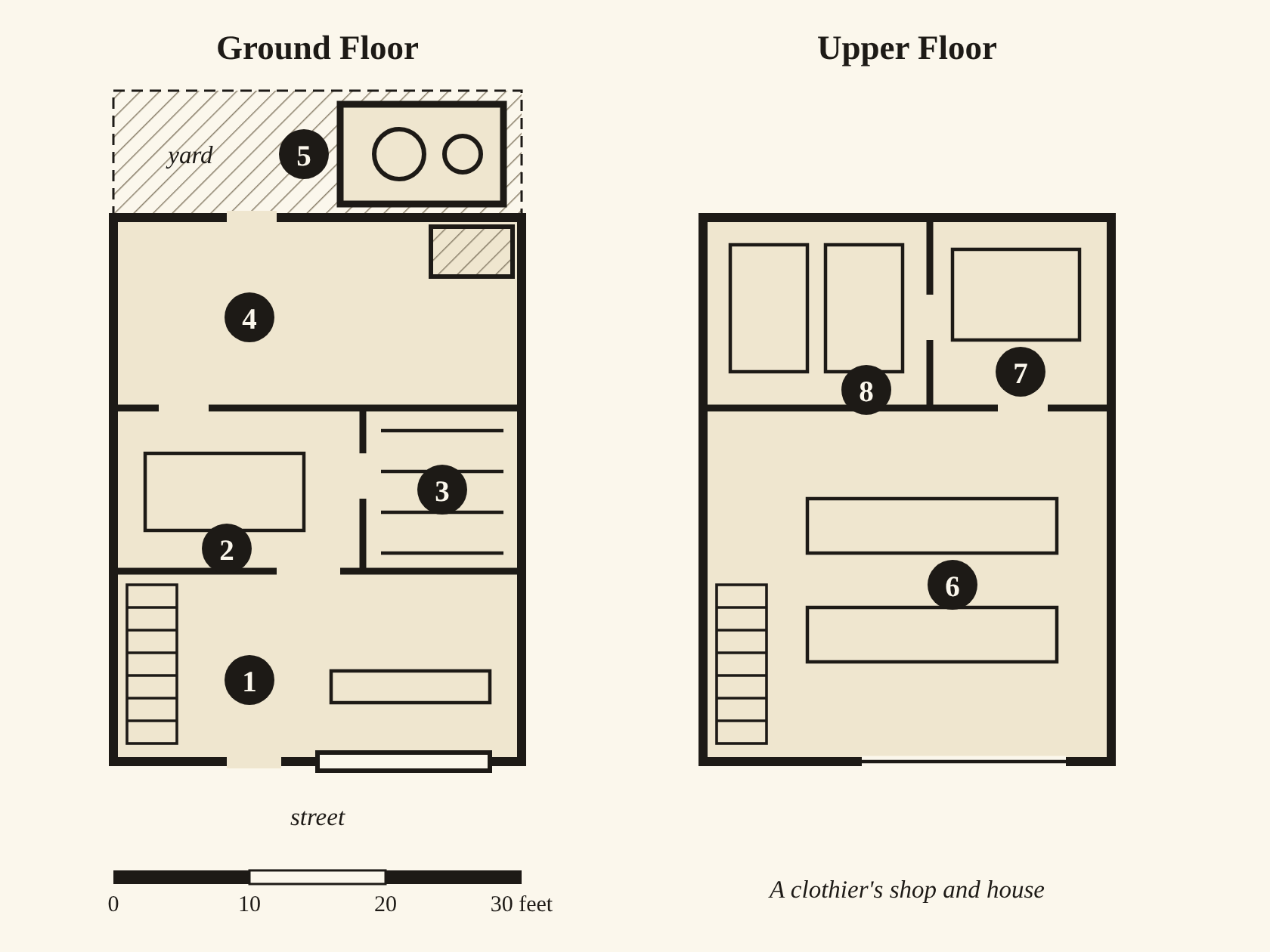
Size: 6 Quality: ✰✰✰ Prices: Above Average. The shop of a prosperous master tailor in a Kaldoric market town, much like several I have visited. The master, his journeymen and his apprentices live above the shop; a dye shed stands in the yard behind. The details may be changed to suit any town. (Inkhorn)
Ground Floor
[1] Shop. The street front opens on a shutter that folds down as a counter. Bolts of cloth stand on the shelves; a chest holds finished garments awaiting collection, each tagged with its owner’s name. The master takes measures here and keeps his accounts in a ledger.
[2] Cutting Room. A broad table under a good window, with shears, chalk, patterns of stiff buckram, and the heavy pressing iron. Only the master and his senior journeyman cut cloth.
[3] Stores. Bolts of linen, serge, broadcloth, and a little worsted; skeins of thread; a locked chest of silk and furs.
[4] Kitchen and Hall. Meals, warmth, and gossip. Apprentices sleep here in winter.
[5] Dye Shed. Two vats and a kettle over a fire pit; drying poles in the yard. The smell reaches the neighbours.
Upper Floor
[6] Sewing Loft. The best light in the house. Journeymen and apprentices sit cross-legged on two long benches from dawn to dusk.
[7] Master’s Chamber. The master’s bed, his strongbox, and the household’s best clothes.
[8] Journeymen’s Chamber. Two narrow beds and a shared chest.
Adventure Hooks
The Mossy Green
The recipe for the prize-winning green from Minarsas is a jealous secret, and every dyer in Kaldor wants it. A rival master hires the characters to learn it; the dyer who owns it hires them to stop him.
The Chyrefal Process
The master clothier of Chyrefal will not share her fulling process. A guild chapter on the mainland offers a franchise, or its value, to whoever brings the secret home.
A Shipment of Purple
Forty ounces of Tazach purple, worth 2,000d, have vanished between Golotha and Coranan. Mercantylers, perfumers, and the Lia-Kavair all want it back, and none of them trusts the others.
The Masterpiece
A journeyman friend must finish his masterpiece, a full set of court dress, before the syndics sit. His silk has been stolen, and his rival sits on the board.
Too Daring for Court
A Cherafir clothier’s agent sends a gown to Chybisa that is too daring for the queen’s court. A courtesan buys it and wears it to court on the arm of a baron. Someone wants to know who arranged the scandal.
Impersonation
In Coranan a character is seen in a crimson cloak bought second-hand from a magistrate’s household. The legion takes an interest.
Sources and Additions
This section is set down plainly. It lists what in this account comes from Columbia Games’ published materials, and what the Inkhorn Fellowship adds; the additions are marked (Inkhorn) in the text.
Published sources
- Columbia Games, Guilds (#4800): ranks, franchises, syndics, the Mangai, guild badges, and the Clothiers’ Guild entry (badge: gules, a woolsack proper; tailor, glover, draper, haberdasher; dyer, weaver, furrier; unguilded spinners and weavers).
- HârnDex 3e: Clothiers’, Chandlers’, Hideworkers’, Mercantylers’, Perfumers’, and Courtesans’ Guilds; Mangai; Franchise; Coat of Arms; Leggings.
- HârnWorld 4e, Economics: incomes (clothier 10f a day, 60d a month).
- HârnMaster 3e core: Character 15 (Clothier: Textilecraft/5, Hidework/4, Jewelcraft/3, Script); Skills (Textilecraft); Combat 5 (cloth armour); encounter tables (clothiers about 6% of urban guildsmen).
- Weaponcrafters (#4834): armourers make protective cloth and quilt garments and buy base garments from clothiers.
- Household: Clothing Index, the social weight of dress, clothing kept a year as best and then as second best.
- Kingdom articles: Kaldor (Clothing and Dress; the dye award; Esenor), Kanday, Melderyn (Chyrefal’s fulling; furs reserved), Chybisa (cloth, dye plants, the House of the Silken Veil), Rethem, Tharda (badges of rank and impersonation), Orbaal, Ivinia, Menglana (Thegholm), Azadmere, Evael (clan Enime).
- Fan price list v7.32: the clothier’s list, cloth by the square yard, and dyes.
The Fellowship’s additions
- The masterpiece (a full set of clothes for a person of rank) and the guild weaver’s mark on market cloth.
- Journeyman wages of 20–40d a month (a third to two thirds of 60d, per Guilds).
- Fur-lined garments priced by their pelts (Columbia’s Hunting article): squirrel-lined pelisson 463d, ermine-lined 3,312d, fur-lined mantle 516d.
- Costly dyes at a quarter of the fan list’s prices (indigo 10d, saffron 40d, dragon’s blood 42d, Tazach purple 50d the ounce), to fit the rest of the economy.
- The clothier’s services (alteration, mending, dyeing, fulling, embroidery, laundering), which are in the Fellowship’s Hârnic Hire List.
- Russet priced at 5d the square yard, below serge (fan list 12d), following its medieval use as the cloth of the poor.
- The fabric model: price = square yards × cloth price + sewing; silk takes ×1.5 sewing. The wool tunic stays at 44d.
- Undergarments count as layers of cloth armour.
- The division of leather work between clothiers and hideworkers, and Peonian charity sewing.
- Master Ordael’s shop, its household, and the adventure hooks.
- Second-hand prices (half for second best, a quarter for worn).
- All the clothing in this account is in the Fellowship’s Hârnic Price List at these prices, made for one size (±10% weight and price for each size from 6).