Dress on Hârn
What Hârnians wear, where, and why: a companion to the Clothiers’ Guild
Version 1.0 · November 2026 · the current edition is kept here, at 4hmlb.com/library/dress-on-harn.html · send word to vaidenon@4hmlb.com
“Before a stranger opens his mouth, his clothes have spoken for him. Here is my account of what they say, realm by realm and from the skin out. For those who keep a table, the rules are set down plainly in the first part; the second part is for those who, like me, cannot leave a hem alone.”
— Vaidenon of Hustan, Warden of the Inkhorn Fellowship, Tashal, Navek 720 TR
Clothes are the first thing anyone on Hârn knows about a stranger. A glance tells a guard whether to bow or to bar the gate, a merchant what to charge, and a knight whether to draw. People are judged, and given courtesy, according to the clothes they wear, and nothing counts for more in a first impression. I learned this young, in a borrowed coat, at the door of a Tashal temple school.
This account of what Hârnians wear, and why, is in two parts. At the Table gives the gamemaster what is needed in play: what each kind of person looks like, what an outfit costs, and how it protects. For the Historian goes garment by garment and realm by realm, for those who enjoy the detail. Players never need to know the difference between braies and hose; their characters simply look the part.
Part One: At the Table
What They Look Like
The Household article rates how well a household dresses with its Clothing Index (CLI). The table below gives an outfit for each band, a man’s and a woman’s, with what it costs new from a clothier and what it weighs. Few people buy everything new: most clothing is kept a year as best wear, a year or two as second best, then given away. A peasant’s outfit is usually older, patched, and partly home-made.
| Appearance | CLI | Man (new) | Woman (new) |
|---|---|---|---|
| Ragged | 1–4 | rags: an old tunic, bare legs | rags: an old kirtle |
| Peasant | 5–8 | 95d 2f, 11.6 lb | 110d, 14.2 lb |
| Decent | 9–12 | 116d, 12.2 lb | 136d, 14.2 lb |
| Middle Class | 13–16 | 251d, 26.2 lb | 252d, 26.5 lb |
| Good | 17–20 | 349d, 25.6 lb | 320d, 24 lb |
| Decadent | 21+ | 1622d, 22.3 lb | 1697d, 14.5 lb |
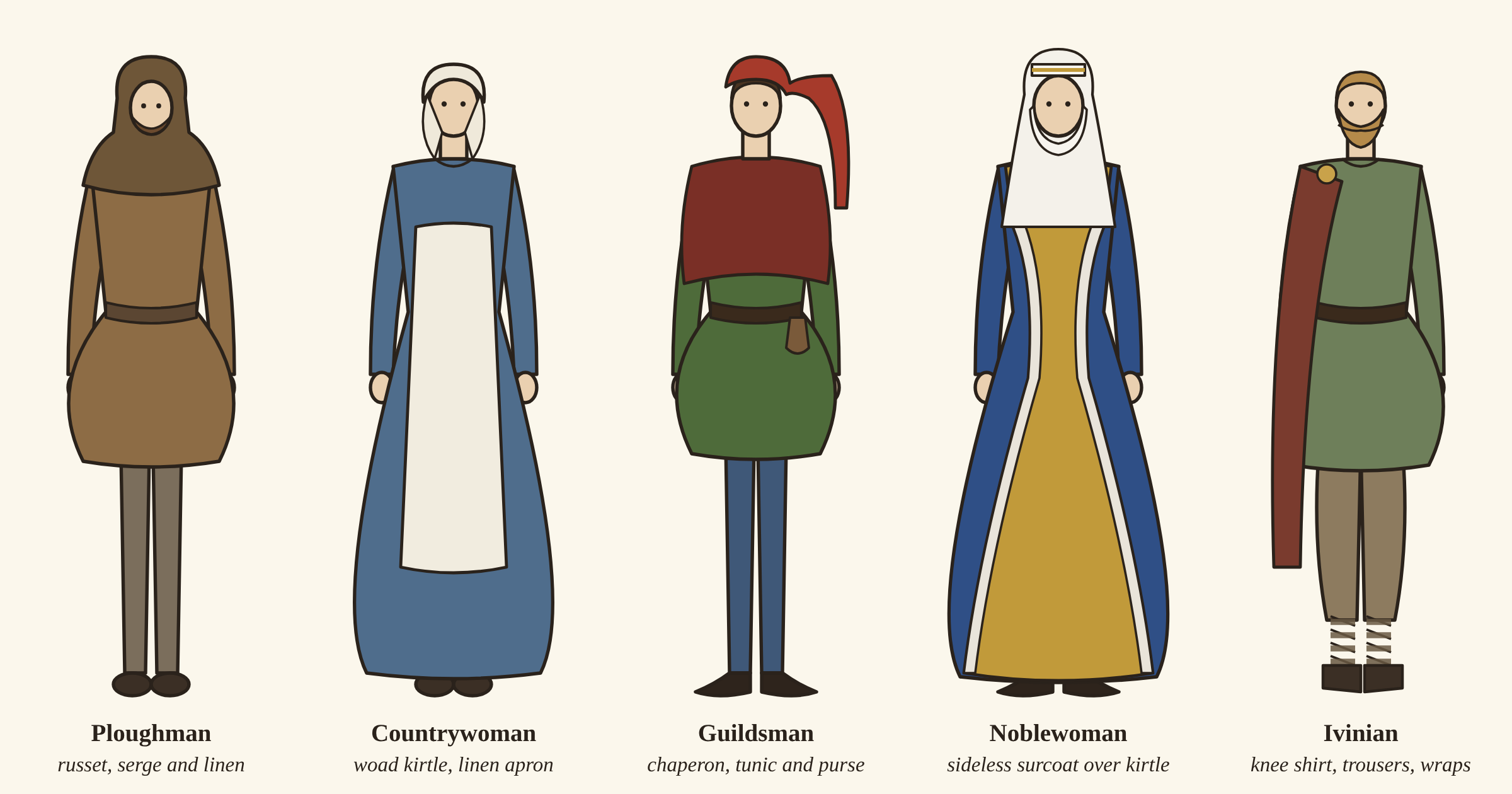
Peasant. Man: linen shirt, linen braies, wool hose, russet tunic, russet hood, leather shoes. Woman: linen smock, wool hose to the knee, russet kirtle, linen apron, linen kerchief, leather shoes.
Decent. Man: linen shirt, linen braies, wool hose, wool tunic, wool hood, leather shoes, leather belt. Woman: linen smock, wool hose to the knee, wool kirtle, linen apron, linen veil, leather shoes, leather belt.
Middle Class. Man: linen shirt, linen braies, wool hose, wool tunic, wool surcoat, wool chaperon, wool cloak, calf boots, leather belt. Woman: linen smock, wool hose to the knee, wool kirtle, sideless surcoat (wool), linen veil, linen wimple, wool cloak, leather shoes, leather belt.
Good. Man: linen shirt, linen braies, wool hose, worsted tunic, wool surcoat, worsted mantle, felt hat, knee boots, leather belt. Woman: linen smock, wool hose to the knee, wool kirtle, sideless surcoat (wool), worsted mantle, linen veil, linen wimple, silver brooch, leather shoes.
Decadent. Man: silk shirt, linen braies, silk hose, silk tunic, squirrel-lined pelisson, fur-lined mantle, silk hat, knee boots, silk gloves. Woman: silk smock, silk hose, silk kirtle, sideless surcoat (silk), fur-lined mantle, silk veil, barbette and fillet (silk), silk gloves, leather shoes.
Clothing as Armour
Everyday clothes are cloth armour: each layer gives B1 E1 P1 F1 where it covers (HârnMaster, Combat 5). A shirt under a tunic is two layers on the body; hose and braies are two on the thighs. At the table, it is enough to say, “everyday clothes: cloth, two layers on the body and thighs, one on arms and lower legs, plus a hood if worn.” Characters who want to count every garment may do so with the Fellowship’s Hârnic Price List.
Looks Around Hârn
- Kaldor: bright colours where they can be afforded; fine local woollens; outer-shire folk in wide-brimmed sheepskin hats and undyed wool cloaks.
- Kanday: heavy collared cloaks and the brimless wool korbi on the western shores; guildsmen in bright red and blue; flamboyant nobles in wool lined with silk.
- Melderyn: cut and fit above colour; embroidered peasant dress with buttons and taping; pointed shoes and pleated sleeves at court.
- Chybisa: rough linen and hemp, brightly dyed; wimples for respectable women; wide sleeves for the rich.
- Rethem: drab, loose clothes for peasant women; dark rich colours for noblemen, and always a weapon.
- Tharda: fashions that change with the season; trousers in high boots; cloaks only in bad weather or as badges of rank.
- Orbaal and Ivinia: knee-length wool tunics, baggy trousers, wrapped lower legs; women in long wool dresses with linen aprons pinned by brooches.
- Azadmere: Khuzan tunics and breeches, richly embroidered in blue and purple; the Jarin of Habe much like those of Orbaal.
Part Two: For the Historian
Hârnic dress resembles that of northwestern Europe around the year 1300, or so my Terran correspondent, Lesli of Bifel, assures me; I take his word for it. People dress in layers, from linen next to the skin out to wool and fur, and each layer has its name and its purpose.
From the Skin Out
| Layer | Men | Women | Purpose |
|---|---|---|---|
| Next the skin | shirt; braies | smock (chemise) | linen, the layer that is washed |
| Legs | hose to the thigh, tied to the braies; trousers in the north and east | hose to the knee, held by garters | warmth; wool cut on the bias |
| Body | tunic to the knee | kirtle to the ankle | the everyday garment |
| Over | surcoat or tabard; pelisson in winter | sideless surcoat; pelisson | show, warmth, heraldry |
| Outer | cloak, mantle, chaperon, hood | cloak, mantle, hood | weather and rank |
| Head | coif; hood, hat, or korbi | veil, wimple, barbette and fillet, kerchief | modesty, status, weather |
| Hands and feet | gloves or mittens; shoes, boots, pattens | the same | work, weather, and mud |
Braies, Hose, and Leggings
A man’s legs are covered by two separate stockings, the hose, cut from woven wool on the bias so that they stretch a little, footed or strapped under the foot, and tied at the top to the drawstring of his braies: loose linen drawers that reach toward the knee. Women’s hose reach only to the knee and are held up with garters. The old books call the joined form leggings (in mail, chausses); soldiers wear them, and so does anyone who wants one garment for the job. In the north and east, men wear baggy trousers instead, often bound below the knee with wraps of leather or woven wool.
Tunic, Kirtle, and Surcoat
The tunic, or cote, is the main garment: a man’s reaches the knee and a woman’s kirtle the ankle, fitted at the body with tight sleeves. Over it goes the surcoat, loose and often sleeveless, the garment on which a knight’s arms are embroidered. The sideless surcoat, its armholes cut so deep that the kirtle shows from shoulder to hip, is the newest fashion for women of means, and the despair of every chaplain I know. The pelisson, a fur-lined over-tunic, is the winter coat of anyone who can afford one; its fur tells the observer how much.
Cloaks, Mantles, and Hoods
Everyone who travels needs a cloak. The poor wear a hood with a short shoulder cape; townsmen wear the chaperon, a hood with a long tail, the liripipe, that may be wound about the head as a hat, and mine is wound so most days. A mantle is a fine semicircular cloak worn for show and fastened with a brooch or cord. Shepherds and travellers favour a cloak with its own hood. In winter the wealthy wear the pelisson, an over-tunic lined with fur; the lining is most of its price, for a squirrel lining takes about a hundred skins, and ermine is a king’s fur.
Shoes and Small Things
Townsfolk wear leather shoes, travellers and riders calf or knee boots, and those who must stand in mud wear wooden pattens over their shoes; Tashal in Morgat is a town of pattens. Soft leather slippers are for indoors only. The poorest, and pilgrims under a vow, go in sandals of plaited rope or straw. Gloves are a mark of some standing; furred gloves keep a rider’s hands warm in winter.
Headwear
A respectable woman covers her hair in most realms. A married woman’s headdress is the barbette, a linen band under the chin, with a fillet about the head, worn with a veil; the wimple wraps neck and chin. In Melderyn the wimple is giving way to bare hair dressed with jewels; in Tharda few women cover their hair even after marriage. Men wear coifs under their hats and hoods, and most wear something on their heads out of doors. I have never trusted a man who goes bareheaded in the rain.
The Realms
Kaldor
My own Kaldor’s wool industry produces a vast array of cloth in many colours, most of it finished in the populous heart of the kingdom between Tashal, Ternua and Kiban. The folk of the outer shires, my Hustan among them, seldom see the fine woollens made from the wool they shear and spin, and wear wide-brimmed sheepskin hats and cloaks of undyed wool; I wore both until I was twelve. The court is intensely competitive, governed by a maze of unwritten rules, and certain furs and dyes belong by custom to certain ranks, offices and sexes. Most Kaldorans love bright colours, but only guildsmen and nobles can afford the brightest greens, yellows and blues. Outside the court, nobles spend more on Khuzan arms than on finery.
Kanday
The wool trade makes dyes dear in Kanday, and peasants wear common herbal colours. On the windward shore the heavy collared cloak and the korbi, a warm, brimless wool cap, are favourites; south of the Eryn, sheepskin hats and lighter cloaks. Freemen take pains to look unlike the unfree; guildsmen wear the brightest reds and blues, and Halean merchants something of Eryn Yellow. Kandian nobles are flamboyant: brightly coloured wool lined with silk, silk and linen blousons at court, mink and sable for trim, and sealskin only for the families of the earls and the king. Fox fur is a mark of low esteem, as any Kandian will tell you before you have finished putting on your hat.
Melderyn
Melderyni dress is highly stratified by class. Peasant clothing is much as elsewhere but adorned with embroidery, taping and buttons; peasant women favour tight bodices and dress their hair with ribbons and flowers. The upper classes wear local wool, furs from the north and west, linen from Emelrene and silk from Lythia. Pleated sleeves and pointed shoes are the fashion at court; men wear short doublets and patterned hose, women robes with overtunics. Sable, mink, seal and ermine are reserved for nobles; guildsmen trim with beaver and rabbit. Cut, fit, materials and workmanship matter more than colour. My mother, who was Melderyni, judged every coat in Tashal by its seams.
Chybisa
Chybisa’s flax and hemp clothe its commoners: rough linen for daily wear, rougher hemp for outerwear. Those who can afford it wear wool and fine linen, the wealthy layered and draped to show each fine material, with wide sleeves that say they do not work with their hands. Dye plants grow everywhere, and even the lowliest peasant wears bright greens, blues and yellows; a Chybisan market looks like a herb garden in flower. Respectable women cover their heads, most often with the wimple; men wear banded caps or, among guildsmen, a hooded cowl with a liripipe.
Rethem
In the lower Thard Valley townsfolk dress as in any market town. In the Agrikan lands warriors go clean-shaven with long hair, braided for battle. Peasant women dress drably and loosely so as not to be noticed, and travel in over-cloaks that hide their frames. Noblewomen of Golotha wear elaborate coiffures, bright colours, gloves and richly adorned cloaks over their indoor clothes; noblemen dress richly in dark colours and always go armed. In some Agrikan lands non-Agrikans may not wear red or orange. I travel there in grey.
The Thardic Republic
Trade along the Thard makes Thardic dress cosmopolitan, and Thardic tailors know it. Men crop their hair and shave; women wear theirs long and plaited with ribbon, and seldom cover it. Fashion changes with the season: men wear loose, heavily embroidered trousers tucked into high boots under layered tunics or tabards; women wear flowing gowns cinched at the waist and open at the back; shoes end in pointed toes. Peasant women may wear trousers without shame. The rich sell last season’s clothes, so that even poor country folk may wear threadbare finery. Some marks are fixed by law: only senators wear purple cloaks and gold thumb-rings, marshals and magistrates crimson, legion officers silver rings, and a feather in the cap marks legion service. Misuse is the crime of impersonation.
Orbaal and Ivinia
Ivinian men dress warmly in knee-length wool shirts, baggy trousers and low leather boots, with the lower legs wrapped in leather straps or wide bands of woven wool; they braid their hair and beards and decorate them with rings and beads. Women wear ankle-length wool dresses belted at the waist, with linen aprons pinned by brooches whose quality shows a woman’s standing and passes from mother to daughter; married women cover their hair with a scarf. The Jarin dress much the same, with trousers bloused into their boots, and their brooches are famous for their intricate designs. The finest I ever saw was on a Jarin grandmother in Tashal market, and she would not sell it.
Azadmere
Khuzan fashion changes slowly, even for a people who live three centuries; a Khuzan of my acquaintance wears his grandfather’s tunic and calls it new. Both sexes wear wool tunics and breeches, women’s tunics to mid-calf and men’s above the knee, belted, with a layered over-tunic; at home women wear long loose dresses. Clothing is richly embroidered and brightly dyed, purples and blues above all. The finest worsted is kept for public wear; plain serge is for the forge and the mine. Winter cloaks reach the ankle and are often fur-lined. Leather garments are of soft sheep and goat leather from Habe. The Jarin of Habe dress like their kin in Orbaal.
Faith, Office, and Trade
Clerics wear habits and robes in the colours of their churches; Agrikan lands keep red and orange for the faithful. Heralds and knights wear arms on surcoats and tabards. Guild badges may be worn on garments, but no larger than six inches and not in the middle of the chest or back; the Fellowship, having as yet no charter, wears its inkhorn on the sleeve and hopes. Courtesans set fashions, and dresses too daring for a lord’s wife often end in a courtesan’s wardrobe.
Wear and Care
Good clothing lasts. A household expects its best clothes to serve a year, then to become second best, and after another year or two to go to the poor. Linen is washed; wool is brushed, aired and mended. Second-best clothes fetch about half their price, worn clothes a quarter, and stolen finery is easy to spot, for it seldom fits.