Tongues of Kèthira: A Fan Guide to the Languages and Names of Hârn
Collected for the Inkhorn Fellowship by Vaidenon of Hustan
Written by Lesli of Bifel and his homunculus, Claudin
Version 1.0 · November 2026 · the current edition is kept here, at 4hmlb.com/library/tongues.html · send word to vaidenon@4hmlb.com
“Every name a stranger gives you is a letter from his grandmother’s hearth, written in a hand you have not yet learned. I have spent my life learning the hands. Here are the tongues of Kèthira as the scholars of the Fellowship have heard them, set in order by Lesli of Bifel, whose homunculus Claudin counts letters faster than any clerk in Tashal. Where we have erred, send word to the sign of the Inkhorn.” — Vaidenon of Hustan, Warden of the Inkhorn Fellowship, from the preface to his collection, Tashal, the 14th of Ilvin, 720 TR
Foreword: how to use this guide
“Mark you, boys: a name is the first gift a stranger makes you and the last thing he takes back. Item, learn to hear where a name was born. Item, learn why it was born there. Item, learn to make one a Tashal clerk would write without a blot. The first is half of history and the second the other half; the third, the Shield willing, is grammar, and grammar is what I am paid for.” — Abalon of Grentyne, tutor of grammar and rhetoric, from the slate-book of his school, Tashal, the 4th of Nolus, 720 TR
This guide proposes to explain where the names of Hârn come from and how to make new ones that honour Columbia Games’ HârnMaster setting. It is built on a close reading of the published names, a family tree of languages taken from Columbia Games’ own Lythia article, and a set of real-world sound models that we tested against those names letter by letter.
It is written for three readers at once:
The game master who needs a Kaldoric miller, a Hodiri horse-thief, or an Azeri merchant in the next thirty seconds. Every chapter ends with sample names you can use as they stand.
The Hârn enthusiast who wants to know why Tashal and Coranan sound different, and what an Old Hârnic place name is doing in the middle of a Melderyni shire.
The amateur linguist who wants to see the evidence and the method, and to argue with them.
How it is laid out. Each chapter opens with a short excerpt from a scholar of Kèthira, then steps outside the world to explain what we found and how. The scholars are a mix of people Columbia Games has published (a tutor in Tashal, a loremaster in the Gibbet Tavern, a Bujoc harper) and a few we have added to cover distant lands and older times. Each speaks as a person of their own place and trade would, and dates their words by their own reckoning, with the TR year beside it. They are listed, with what we invented and what we borrowed and how each counts the years, in the last chapter.
What is canon and what is ours. We are careful to keep three things apart throughout:
| Kind | What it means here | How it is marked |
|---|---|---|
| Published | Names, languages and facts printed by Columbia Games | “printed,” or a book named |
| Reading | Our interpretation of printed evidence (a pattern we see in the names) | “we read,” “the evidence suggests” |
| Invention | Our own additions: sound models, rules, sample names, scholars | “we propose,” “HMLB (HârnMaster, as Lesli of Bifel plays it)” |
Nothing here overrides anything Columbia Games has printed or will print. Where our models and a future publication disagree, the publication wins and the model should be retuned.
A fan work. HârnWorld and HârnMaster are trademarks of Columbia Games Inc.; Hârn, Kèthira and Lythia and their names are theirs. Hârn was created by N. Robin Crossby. This is an unofficial, non-commercial guide written for private play and shared in the spirit of the many fan articles at Lythia.com. It quotes printed names and a few short phrases only; it reproduces no maps, tables or passages. If you have not read the published material, please buy it: everything good in this guide grew out of it.
contents ↑1. Method: from markers to models
“Three questions, novices, in this order. First his name; second his father’s; third the name of the brook below his village. The first he may lie about, and the second he may not know; the third he gives freely, for nobody thinks a brook a secret. The Archive holds some four thousand such answers. I have yet to find a brook that lied.” — Chulis Jekesa, Save-K’norian scholar, On the Testimony of Names, read to the novices of the archive at Cherafir, the 12th of Kelen, 711 TR
We started from one question: can the names Columbia Games prints tell us how its languages sound? The answer turned out to be yes, often clearly. The work ran in five steps.
Step 1: gather the evidence
We collected every name we could attribute to a people or a realm:
10,176 given names borne by 13,549 people named in Columbia Games’ published material, each tied to the realm or people it belongs to.
4,422 settlements, 1,730 clans and their realms, from the published maps and texts.
About 330 tribal names and words from the tribe chapters of Barbarians, Tribes of the Kubora and the Patrel article.
The language tree in Columbia Games’ Lythia article (the families, their members and their mixed tongues), the language and script tables of the core rules, and the descriptions of how each family sounds.
Step 2: look for markers
A marker is a spelling feature that is more common in one group’s names than in everyone else’s. We counted every letter, letter pair, beginning and ending in each group and compared it with the rest. Only clear differences count. A few of the strongest:
| Group | Marker | Share in this group | Share elsewhere | Printed examples |
|---|---|---|---|---|
| Tharda (people) | the letter z | 4.1% | 1.3% | Abraz, Cyzor, Ezarn |
| Tharda (people) | ending -os | 2.1% | 0.6% | Avathos, Girondios |
| Rethem (people) | the letter k | 19.2% | 11.3% | Barzak, Hordak |
| Kaldor (people) | the letter c | 9.3% | 7.0% | Cynric, Ealfric |
| Kaldor (people) | ending -wyn | 0.8% | 0.2% | Arwyn, Bronwyn |
| Orbaal Jarin (people) | the letter y | 45% | 17% | Gwenys, Braedyn |
| Tharda (places) | ending -nar / -inar | 8.1% | 0.5% | Delinar, Helnar |
| Melderyn (places) | the letter x | 3.7% | 1.2% | Gustox |
| Orbaal (places) | ending -heim | 9.5% | 1.0% | Balheim |
| Kanday (places) | ending in a vowel | 38% | 24% | Abery, Miona, Vogla |
The markers do two jobs. They show that Columbia Games’ writers gave each realm a recognisable voice, and they give us a checklist: a generated name for Tharda should show its z and its -os about as often as the printed ones do.
Step 3: find a sound model
For each family and people we then asked which real-world language its names sound most like. We built a small statistical model (a letter-pair, or bigram, model) from about thirty genuine names in each of roughly thirty candidate languages. Each model then scored how naturally the printed names read in it.
Scores are relative. Some languages, rich in open syllables, fit almost anything, so each candidate’s fit to one group is measured against its average fit to all groups. A lead of +1.5 or more is a finding; a lead under +1.0 is only a hint, and small samples (seven to twenty names) are hints at best.
| Group | Best fits | Verdict |
|---|---|---|
| Jarin names | Welsh +1.8, Old Norse +1.1 | Welsh confirmed |
| Ivinian names | Old Norse +1.9, Old Turkic +1.3 | Old Norse confirmed |
| Shoji names | Japanese +2.5 | Confirmed, the clearest of the families |
| Gozyda (tribe) | West Slavic +2.0 | The clearest of the tribes |
| Dromja words | Romani +2.0, Byzantine Greek +1.9 | Romani with a Greek layer |
| Numec names | Hittite +1.5, Latin +1.1 | Anatolian confirmed |
| Azeri names | Latin +0.9, Middle Persian +0.8 | Latin kept, moderately |
| Mafani names | Mandarin +2.4, Swahili +2.1 | Bantu shapes chosen (see chapter 6) |
The test can surprise. Mafani was first modelled as Iranian; Iranian did not reach the top five, so we changed course. Where a test was too thin to call (the Pharic tongues of the mainland), the choice was made by ear and is marked as a choice.
Step 4: weigh print above the model
A real-world language only colours the sound. When we generate names, Columbia Games’ printed names carry two to four times the weight of the model’s list, so the result sounds like Hârn first and like Wales or Norway second. The model also never decides meaning, grammar or history; those come from the published text.
Step 5: listen
Statistics cannot hear. We generated 1,069 sample names across every culture and read them aloud at the table, striking anything that sounded silly, modern, or too close to a famous real person. All 1,069 survived. Every generated name is also checked against the spelling guidance Columbia Games gives for Kèthiran names: no silent letters, and Q without U said as K.
A caution for linguists. Bigram scores reward spelling habits, not sound systems, and English-language writers spell everything through an English filter. What we measure is the voice Columbia Games gave each people on the page. That voice is exactly what a game master needs to match.
Step 6: the elder tongues
Khuzdul and Sindarin are not built like the human tongues, so a sound model alone could not catch them. For the Khuzdul we rebuilt a root-and-pattern grammar from the printed military words and clan names (chapter 9). For the Sindarin we joined everyday words with the Welsh soft mutation and rolled clans on Evael’s own table (chapter 10). Both were then tested against the printed names the same way: on our fit score, the new Khuzdul names moved from −2.46 to −1.41 against the printed names’ own −1.33, and the Sindarin from −1.75 to −1.60 against −1.34. Both follow Tolkien’s diacritical marks, which chapter 10 explains.
contents ↑2. The nine families of Lythia
“Nine are the mothers of men’s speech, O reader, and I have bargained with the daughters of all nine. The Jarin sing their prices; the Ketari haggle as a priest chants, by rote and without mercy; my own Azeri kin, may the Archons forgive me, dispute an onion as though a magistrate sat in judgment over it; the Mafani click like water over a weir. Learn the mothers, and no market under heaven will make a fool of you twice. Once, assuredly; I speak from experience.” — Phoretios of Karejia, Lexicon of the Tongues of Men, preface, written in the eleventh year of the forty-first Cycle of the Archons (c. 210 TR)
Columbia Games names nine families of human speech and draws how they descend in its Lythia article. Everything in this chapter’s first two columns is theirs. The sound models in the last column are ours, chosen and tested as chapter 1 describes. A dagger (†) marks a dead tongue.
| Family | Root | Where it is spoken | Its tongues (selection) | Sound model (ours) |
|---|---|---|---|---|
| Jarind | Jarind † | Hârn, Emelrene, Altland, Ivinia | Jarinese, Emela, Old Hârnic † → Hârnic; Altish, Yarili | Welsh; Hârnic adds an Old English and Norman layer |
| Pharic | Phari † | Ivinia, Harbaal, Palithane, Shorkyne, Trierzon, Quarphor | Ivinian, Harbaalese, Palithanian; Quarph, Shorka, Trierzi | Old Norse; Gothic; Anglo-Norman; Lombard Italy |
| Azeri (Venarian) | Azeri † | Azeryan, Karejia, the Venarian shores, Byria | High and Low Azeryani, Byrian; Karejian, Elbythian | Latin; a Greek cast for Karejian |
| Anzelan | Anzela † | Anzeloria | Tuvarese, Thonian, Pechalari, Wernai | Akkadian, with doubled vowels for length |
| Mafani | Mafani † | the Gulf of Mafan and the Shentu Sea | Shenti, Thota, Mafanese | Swahili shapes with Xhosa click letters |
| Molkuren | Molkuri † | Molkura, Kaneum, Homora and neighbours | Homori, Molken, Lashoi, Kanic | Thai |
| Reshenic | Resheni † | Jankor, Argola, Mengola, Shoju | Jankorian, Argolan, Mengolan, Shoji | Chinese; Mongolian; Japanese |
| Ketaric | Ketar † | Ketarh, Reksyna, Diramoa, Beshakan, Dalkesh | Ketari, Diranese, Reksyni, Besha, Dalken | Persian; an Arabic colour for Besha and Dalkesh |
| Numec | Hepeka † | Hepekeria | Numer, Falani, Korlic | Hittite |
Mixed tongues
Columbia Games also prints tongues with two parents. They matter for names, because a mixed tongue mixes its naming habits too:
Old Hârnic = Old Jarinese reshaped by Pharic-speaking invaders. This is why Hârnic names sound like Welsh with an English layer.
Orbaalese = Ivinian, Hârnic and Jarinese together, the speech of conquered Jara.
Harbaalese = Ivinian with Altish; Palithanian = Ivinian with Trierzi and a touch of Emela.
Trierzi = Old Trierzi with Low Azeryani; Elbythian = Karejian with Besha; Byrian = Azeryani with Tuvarese.
Kamakin, the tongue of Hârn’s Kamaki, = Jarinese laced with Falani and Thonian (Numec and Anzelan).
The elder tongues
Sindarin, Khuzan, Ivashi and the five gargun tongues belong to no human family. Each stands alone. We have not yet built models for Sindarin and Khuzan beyond the printed names (chapter 9).
A reading that explains two puzzles
Two Hârn tribes are described in print in two apparently contradictory ways:
The Bujoc are listed among the Jarin tongues, yet their tribe chapter calls their speech a dialect of Hârnic.
The Solori are listed in the Azeri family, yet their chapter says they speak a simple Hârnic dialect with a holdover from their old tongue.
We read each pair as one story told from both ends: one description gives where the speech came from, the other how it sounds now. The Bujoc kept a related tongue that drifted toward Hârnic over nine centuries; the Solori lost an unrelated tongue and kept its bones. Chapter 7 follows both stories in detail.
The tree below shows how Hârn’s speech sits among the families.
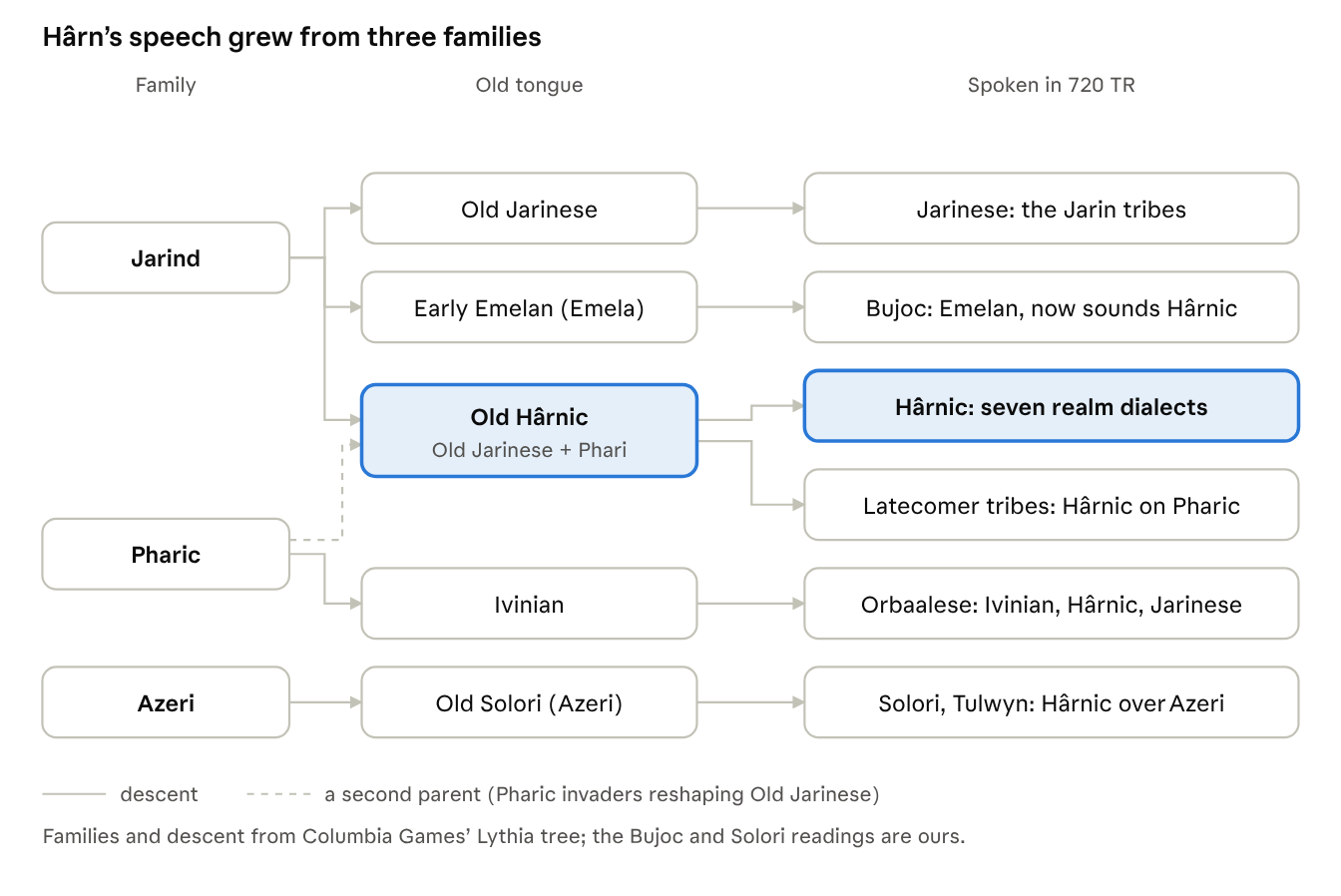
Hârn’s speech in the Lythia tree · three families, nine tongues
Every Hârnic dialect, Pharic-latecomer tribe and the Solori lead back through Old Hârnic; only the Jarin tribes, the Bujoc and the Orbaal Ivinians took other roads.
contents ↑3. Layers of time on Hârn
“The Corani took a conquered man’s name as they took his horse: curried it, shod it, rode it to Coranan. Two generations, and a chieftain’s bark was an emperor’s cognomen. Scrape a Thardic name with a knifepoint. Under the gilt is a tribesman; under him a Jarin; under the Jarin something older that no clerk in this city can read. I have asked most of them. I have threatened two.” — Sir Adelrin Lanegrun, scholar of Corani history, in a letter to a colleague in Coranan, Golotha, Savor 718 TR, which out of habit he dates the 418th year of the old Corani count
Names change with the centuries, and Hârn’s history gives them clear layers. The events are Columbia Games’; the naming models for each era are ours.
What the evidence shows
Among Hârnic rulers’ names, Germanic-looking endings (-ric, -ald, -wic, -gar) make up 21% before 500 TR and only 6% after. Older kings carry names like Sanric, Parogar, Nathwic, Shobald and Medrik; later ones like Myselbane, Chidena and Torastra. That matches the Lythia tree: Old Hârnic began with a strong Pharic layer, and the Jarinese underneath kept flowing back as the Jarin were absorbed. The sample is about a hundred names, so treat it as a hint.
The eras and their models
| Era | What was spoken | Model (ours) | Sample names |
|---|---|---|---|
| Before c. 900 BT | Old Jarinese beside Sindarin and Khuzan | Common Brittonic and Gaulish (think Cunobelinos), with the printed Jarin names | Dumnos, Tavinn, Carran; Brigace, Morixa, Cunna |
| c. 900–500 BT, the Atani wars | Pharic invader bands; the Solori’s Azeri tongue | Migration-era Germanic (think Ermanaric) | Hrotiges, Hlewagast, Aethear; Amalda, Gundla, Haricia |
| c. 500 BT–300 TR | Old Hârnic, Old Jarinese | Early royal names in print, Brittonic and early Germanic | Cynrix, Lothwulos, Shorob; Erlida, Korima, Dartiaca |
| c. 300–572 TR, the west | Old Hârnic under the Corani Empire | The printed Corani names with late Roman provincial names | Aricheros, Avicium, Calagnus; Worona, Urica, Calice |
| After 572 TR | Modern Hârnic, in realm dialects | Chapter 4 | Chapter 4 |
The elder peoples keep their names across all these eras. They live long, and Columbia Games gives their tongues no stages. The Earthmasters left no writing, so their tongue stays unknown.
Place names keep the oldest layer
Places keep older names than people do, as English keeps Celtic river names like Avon and Thames. Melderyn shows it best. Its people have soft names that often end in a vowel, but its places are hard and strange: Gustox, Imolik, Roneh. Columbia Games records hints of a civilised culture on the island long before the Jarin, and henge-builders there around 2500 BT. We read Melderyn’s x-, q- and z- places as relics of that lost tongue. It is the oldest layer of speech on Hârn, and the only one nobody has deciphered.
Orbaal shows the opposite process, renaming. Jarin places took Ivinian names after the conquest of 652–686 TR, and in Orbaal a place’s name now tells you who holds it: Jarin names for Jarin lords, Ivinian names (-heim “home,” -stad “place,” -holm “islet”) for clan holdings.
The timeline below sets these layers side by side.
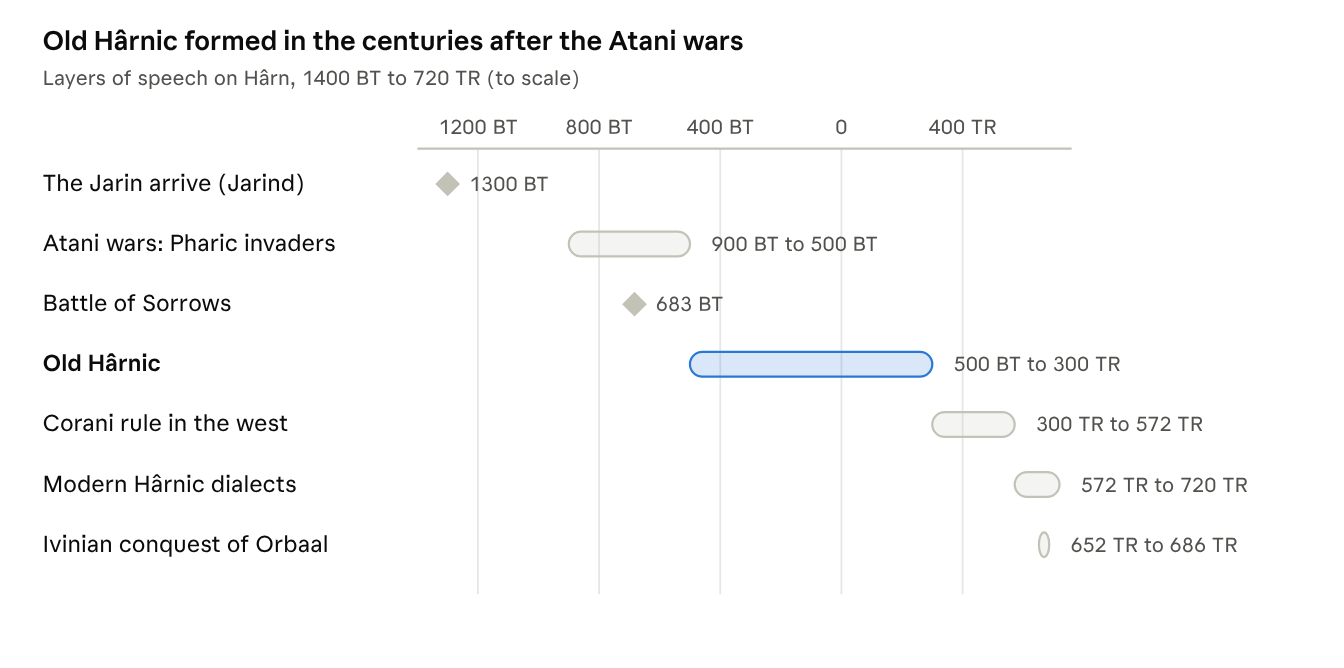
layers of speech on Hârn · 1400 BT to 720 TR
The Jarind base is about 1,300 years older than the Pharic layer that turned it into Old Hârnic; the realm dialects are barely 150 years old.
contents ↑4. The Hârnic realms
“I sat one table with a Thardic factor, a Kandian drover and a Kaldoran man-at-arms. The factor said ‘sev’n,’ the drover ‘seh-ven,’ the man-at-arms ‘sem,’ and each caught perhaps two words in three of the others. All three swore it was the one tongue. So it was, my dears: one tune in three keys, and every man of them certain the other two were singing flat.” — Elwyn of Hilrich, collector of songs and tales for the Harpers, from her commonplace book, Tashal, Halane 719 TR
Hârnic is one tongue spoken in many dialects. Columbia Games tells us travellers from distant realms struggle with each other’s accents and idioms yet mostly find each other merely quaint. So, we give the dialects no barrier in play, only a voice. Better still, the printed names already differ by realm, measurably.
Why the realms sound different
The old Corani frontier is still the main dialect line:
The west (Tharda, Kanday, Rethem) shared one empire, its civil service and its legions for more than 250 years. It speaks a Hârnic coloured by imperial and church Azeri.
The east (Melderyn, Kaldor, Chybisa) grew from small kingdoms on Jarin ground.
The north-east (Orbaal, the Kaldoric hills, Azadmere’s humans) is Jarin country.
The seven voices
| Dialect | What the printed names show | Second names | Model (ours) |
|---|---|---|---|
| Melderyni | soft, often ending in a vowel (-a, -i, -ia, -ey); men’s -ir, -eld, -alt | clan names; branch houses in -sen | the English West Country, where old British names held on longest |
| Kaldoric | hard c (Cynric, Ealfric); Jarin -wyn; -ric, -ris, -in | “of” a place for commoners | the Welsh Marches: a Norman-style court over a Welsh countryside |
| Chybisan | short and plain (Sharat, Jarvis); f-; -rat, -vis, -ith | many go by one name | Border English, between two crowns |
| Kandian | softened western endings -el, -tel (Aehtel, Darentel); ae | more one-name country folk than anywhere | Occitan beside French: the softer southern cousin |
| Thardic | z (Abraz, Ezarn); -os (Avathos); most end in a consonant | “of” a domicile; family names for great houses | late Roman provincial speech turned Byzantine |
| Rethemi | hard k everywhere (Barzak, Hordak); kh- in church names; -esque and -us surnames | clan names | Merovingian Gaul: warlords over provincials |
| Jarin Hârnic and Orbaalese | y (45%), gw-, -yn, -nn, -ys (Gwenys, Braedyn, Rhys) | “of” a place | Welsh under a Norse layer |
The one accent rule Columbia Games prints: Ivinians say J as Y and W as V.
Place names by realm
Places separate the realms even more sharply than people do:
| Realm | Marks of its places | Printed examples |
|---|---|---|
| Tharda | -nar, -inar, -ar; double ll, nn, ss | Delinar, Helnar |
| Kaldor | -el, -rin, -lin, -ald, -in; ch | Lachel, Getha |
| Melderyn | hard and archaic: -ed, x, q, -us, -st, Zu-, Xe- | Gustox, Imolik |
| Chybisa | ia, ae, -ane, y | Lerenil, Namadees |
| Kanday | ends in a vowel; -la, -da, -dy, -yn, -ryn | Abery, Vogla |
| Rethem | ends in a vowel; -ath, -ry, -dy, -ny; th | Ebath, Crady |
| Orbaal | -heim, -holm; ei, aa over Jarin names | Balheim, Elinthorn |
Sample names
All generated by our models; none is printed by Columbia Games.
| Dialect | Men | Women |
|---|---|---|
| Melderyni | Hobirtin of Cadendac, Aridin of Kalcestedel, Belborath the Fairhaired | Lila of Sefult, Cymelena of Subil, Menila of Abrekryvir |
| Kaldoric | Merris of Lureth, Bain the Wise, Tymeris of Atin | Mathiris the Fair, Andra of Hunyandne, Melana of Rona |
| Chybisan | Harelin the Devious, Erken the Old, Maen of Cynath | Nerenia of Ledyn, Fawla of Ulmen, Derenis the Weaver |
| Kandian | Taen of Haen, Merdyn of Sheladasyn, Gelsin the Younger | Bria of Tynalar, Aine the Lean, Eryena the Younger |
| Thardic | Jerborek of Nopouzz, Vulant of Deorutmin, Heren of Nostar | Kena of Sisulnar, Frinana of Bendeinar, Jumer of Teffos |
| Rethemi | Brasis the Old, Branisir of Merdarte, Fain of Kardy | Meryle of Conath, Delilyna the Younger, Eriela the Red |
| Jarin Hârnic | Dugryne of Kursavwys, Branys of Dalenn, Keirnan of Heim | Gwaeredd of Senakholm, Brythylin of Toniel, Bryste of Tyrniwold |
Talking funny at the table
Our proposals for play, none of them rules changes:
No penalty to understand another civilised Hârnic dialect. Tribal dialects keep the published penalty.
Placing an accent. Anyone can tell a western, eastern or Jarin speaker at once. Naming the realm takes an Awareness roll.
First impressions. Between rival realms (a Kandian in Rethem, a Thardic speaker in Tashal), the GM may apply −5 to Rhetoric, Intrigue and Lovecraft at a first meeting.
Passing as a local. Learn another realm’s speech as a specialty, such as Hârnic (Thardic). At ML 70 or more you pass as a native to anyone who fails an Awareness roll.
5. The northern tongues: Ivinian, Altish, Yarili, Emela
“Three tongues the skald must master: hall-speech, god-speech, and the speech of the folk his grandfather’s grandfather harried. Hall-speech wins him mead. God-speech wins him a name the gods will hear. The third tells him, while the benches are still laughing, when to find the door.” — Eryk Fildrsyn, skald of Rogna, said at the mead-bench and set down by a Shorka trader, in the winter the fjord froze out to the skerries (716 TR)
Ivinia is the north’s great meeting of families. Ivinian is Pharic, the newcomer; Altish and Yarili are Jarind, the older speech of the land. Emela, across the sea in Emelrene, is a Jarind tongue so close to Jarinese that Columbia Games suggests the Jarin who settled Hârn came mostly from there.
Ivinian
Model: Old Norse, confirmed by the test (+1.9).
Second names are clan names far more than patronymics (458 to 44 in the printed names), so “son of” is the exception, not the rule. Branch houses take -sen (Daas → Daasen).
Places: -heim, -stad, -by, -borg, -vik, -und, which in Norse mean home, place, farm, fort, bay and the like.
Altish
Model (ours): Old Irish (Gaelic). The Alts are the Jarind people of Altland.
Southern Alts carry a light Gothic colour from their neighbours.
Where Alt meets Ivinian, a mixed Norse-Gaelic pidgin naming style, as Harbaalese mixes Ivinian with Altish in Columbia Games’ own tree.
Yarili
Model (ours): Welsh with a light Sámi colour, for a Jarind people of the far north.
Names take no sex marking, and a person is named “of the X band.” Toward outsiders a Yarili gives an Ivinian name.
Emela
Model (ours): Breton, the Brittonic tongue carried overseas by refugees, which is exactly how Emela relates to the Jarinese of Hârn.
The church tongue. Emela is the liturgical tongue of Larani and Peoni. We propose that clerics of those churches are entered in church rolls under an Emela form of their name.
Sample names
| Tongue | Men | Women | Note |
|---|---|---|---|
| Ivinian | Hari Thaon, Jaregin Lordaar, Oyvin Kaalbyn | Mettea Huraar, Velina Bostaan, Lyne Kaar | given name + clan |
| Altish | Briall, Emed Brigin, Main Sechulach | Domnachela, Eirdra Amlaith, Connaitla Muirch | |
| Altish pidgin | Muibne Ansen, Amlair Nasen, Cormla Baeld | Somaidrun Rogal, Suima Dainsen | Norse clan endings on Gaelic names |
| Yarili | Gwelywen of the Cadfan band, Cadfaer of the Elywen band | Cered of the Caeret band, Iorwen of the Ceredudd band | no sex marking |
| Emela | Ebin Rovan, Bralan, Gwene Alan | Judicana, Melia, Riwalime Leochain |
6. Lythia beyond the sea
“Thus says Ashtafar, Mouth of the King and Tongue that Turns: the conquered teach the conqueror to speak. We rode west with seventeen words for a horse and none for a harbour. Our sons learned the harbour-words from their nurses. Our grandsons recited the poems of the cities we had burned, and mispronounced them, and called the mistakes the speech of their fathers. Let the scribe who copies this change not one sign.” — Ashtafar of Ketarh, Dragoman of the Ketari court, The Book of Interpreters, from the colophon: “written in the month of ripe barley, in the year of the eponym Hurrabel, the ninth of King Sharazzu” (c. 610 BT)
Few characters from Hârn will travel to Molkura or Shoju, but their merchants, slaves, sailors and envoys reach Hârn’s ports. These models give a game master names for them. The test results are relative scores against about thirty candidate languages (chapter 1).
| Family or tongue | Model (ours) | Test | Notes |
|---|---|---|---|
| Azeri: High and Low Azeryani, Byrian | Latin | Latin +0.9 | moderate; High Azeryani is the learned form |
| Azeri: Karejian | Latin with a Greek cast | Elbythian adds a Besha colour | |
| Anzelan | Akkadian, doubled vowels for length | Thai +2.2, Akkadian +2.0 | Akkadian kept so Anzelan does not sound like Molkuren |
| Mafani | Swahili shapes with Xhosa click letters (q, x, c) | Mandarin +2.4, Swahili +2.1 | Columbia Games describes clicking compounds; Iranian, the first model, failed |
| Molkuren | Thai | Thai +0.7 | narrowed from a wider guess; a tonal, precise tongue |
| Reshenic: Jankorian | Chinese-shaped | an old empire of gardens and jade | |
| Reshenic: Argolan, Mengolan | Mongolian | Argola is ruled by a khan | |
| Reshenic: Shoji | Japanese | Japanese +2.5 | the clearest family result |
| Ketaric | Persian | Georgian +1.5, Arabic +1.2, Middle Persian +1.1 | an Arabic colour for Besha and Dalkesh |
| Ketaric: Diranese | Jankorian shapes over a Ketaric base | none clear | Diramoa’s printed names lean Chinese |
| Numec | Hittite | Hittite +1.5 | long vowels and abrupt stops, as Columbia Games describes |
| Pharic: Quarph | Gothic | too few names to test | chosen by ear |
| Pharic: Shorka | Anglo-Norman | too few names to test | chosen by ear |
| Pharic: Trierzi | Lombard Italy: Romance commoners, Germanic nobles | Occitan +2.0, Italian +1.7 |
Sample names
| Tongue | Men | Women |
|---|---|---|
| Azeri | Thebos, Lucium Shoros, Nium Kolos | Inra Luteth, Elisa Aulprium, Kolla Thilis |
| Anzelan | Enlim Bothic, Palhurbai Gelorit, Thonic Aneria | Tukinna, Anesla, Ashaonicia |
| Mafani | Kibwayi Mafaka, Thowe Rehenti, Chosari | Chota, Killa Mokono, Mafakentia |
| Molkuren | Phai Zera, Meluang Dodrexa, Jebed Moro | Kona, Mela Perexa, Lashia |
| Jankorian | Somisa Janor, Bekuanxi Chao, Wankor | Ylina Suzhaibin, Yangna, Huanora Menguoyan |
| Argolan | Tolun Borum, Kheni Batai, Bulun Khene | Buyankora, Seluna, Temukhana Tolaan |
| Shoji | Sekru, Shojo Osei, Tokurghin | Murghe Shinaga, Yora, Kalphoja Murghi |
| Ketaric | Kyamdad Bahir, Kyazd Hapur, Reksyne Umelrin | Kavahidehna Bashir, Umelra, Zerdada Pelonia |
| Diranese | Idenzhan, Mingperi Tenguo, Depanguo Dengperi | Dengperi Kiporom, Kema Ideng, Daola Taizonguo |
| Numec | Siliz Delana, Sili Numeri, Teliz | Lana Delanen, Nuwania Siliz, Hana Numerik |
| Quarph | Usegeric, Athuwulf Amalas, Tirgais Witigen | Amanarica Totigen, Ataultha Sigen, Thiudile Usegeric |
| Shorka | Kael Hargery, Hapel Ebbekin, Aenseling | Haumena Eslo, Quensa Heslonde, Neteline |
| Trierzi | Tengari Cabariane, Gelaris Janoran, Fraban | Azalda Erinsa, Ustila Luiga, Gelanta Jaulgris |
A note on respect. Several models borrow the sound of living languages. We use them only as palettes for spelling and rhythm, never as a portrait of the people who speak them, and we strike any generated name that reads as a joke at a real culture’s expense.
contents ↑7. The tribal nations
“The tribes, now. The tribes are Hârn’s long memory, longer than any lord’s roll, aye. A Kuboran chief swears by words that were grey-bearded when Kemlar the Guide was in swaddling, and the Bujoc sing their grandmothers back nine deep and never drop a stitch. Fill that, there’s a love, and I’ll give you a Jarin lay no lord in Tashal could follow past the first verse. No? Then the second verse costs more.” — Brylwe of Hilrich, loremaster of Jarin folklore, from his stool in the Gibbet Tavern, Tashal, a wet night in Morgat, 720 TR
Read together, the tribe chapters and the Lythia tree sort Hârn’s tribes into three stocks. Arrival dates and homelands are Columbia Games’; the stocks and models are our reading.
First-wave Jarin: still speaking Jarinese
They came c. 1300–900 BT and have kept their Jarinese dialects through two thousand years of isolation.
| Tribe | Printed names | Test | Model (ours) | Sample names |
|---|---|---|---|---|
| Kubora, Urdu, Equani | Gathgur, Dormanuk, Thaleroc, Klesanar | Old English, Old Norse, Welsh all near +1.0 | hard Jarin: Welsh stems with closed, guttural endings (-ur, -uk, -ak) | Klerin, Gomar, Brylerwys; Ranuhna, Obotha |
| Kabloqui | Mequaneki, Kebanaki | too few | Equani with a suffix -aki, -eki, final -q | Oglun Stronghand, Jusin; Kalera, Kebarache |
| Anoa | Cynrog, Elidir, Ethwyc | Old English +1.4, Welsh +1.0 | Welsh, the purest Jarin, with a little Old English | Anfrin, Shelidir; Ethwys, Cynanfrica |
| Taelda, Ymodi | Cealwynn, Cothllynn, Arbogar | Old Saxon +1.4, Old English +1.2, Welsh +1.1 | Welsh with a Saxon cast; Ymodi harder | Osdabir, Niphelen; Eliacha, Wurokka |
| Chymak | Sarfaeda, Bavagatha, Kualthurlu | too few | early Emelan: long, vowel-rich compounds | Marfaed, Saroch Longarm; Erneda, Thata Redarm |
| Adaenum | Olna, Holna, Ulno, Dalaga | Italian +2.3, Latin +2.0 | island Jarin with open endings (-a, -o) | Brezzo, Hodrice, Elfo; Holna, Olire, Enla |
| Kamaki | Tre’clut tu-ek, Retek-sut | Georgian +1.8, Swahili +1.7 | Jarin with Numec and Anzelan sounds: glottal stops, hyphened compounds | Machmace, Chattusut; Anta, Tusila, Karna |
Pharic latecomers: Hârnic over an old tongue
They came c. 830 BT–160 TR from the lands Lythia calls Pharic, took up Hârnic easily (Hârnic is itself Jarinese with a Pharic layer) and kept some words of their own.
| Tribe | Printed names | Test | Model (ours) | Sample names |
|---|---|---|---|---|
| Chelni | Ethelwair, Ferithwic, Ljarl | Columbia Games’ Ivinian names +1.5 | Hârnic over Old Norse and Old English | Ethorn, Weslid; Aelfa, Eingrida |
| Kath | Kurl, Magd, Gurkma | too few | Hârnic over Quarph (Gothic), clipped short | Pahric, Witiger Whitetooth; Tulfila, Sunile |
| Hodiri | Tohkta, Arrak, Kergun, Dharekta | Old Turkic +1.1, Mongolic +1.0 | Hârnic over Pharic, with a steppe layer from the Ketari wars | Jebrun, Arragrim, Pachasak; Rakule, Jebra Ashaxe |
| Gozyda | Lucash, Jakrez, Nytheria | West Slavic +2.0 | Hârnic over a Slavic-cast Pharic | Ludmiez, Leslav Elk Foot; Luca, Nytisl Redtooth |
| Pagaelin | Valdrun, Raunir, Ylla | mixed | Hârnic over Harbaalese; cult names with an Arabic colour | Yaran, Basigunir; Yllabe, Thole |
Azeri-rooted: the Solori and the Tulwyn
The Tulwyn’s 91 printed names (Aladom, Haitolon, Creonar, Charakis) test closest to Occitan (+1.9), Greek (+1.8) and Columbia Games’ own Azeri names (+1.6). We read them, like the Solori, as a people who came from the Azeri south and took up Hârnic. Their honorific Tir- (Tir-Aladom) is printed. Samples: Kolodos, Kairimri, Ethuremar Greyeye; Dorithe Asheye, Pryna, Koda Bear Arm.
The Bujoc: a tongue that drifted toward Hârnic
“In Anadel they gave me a name and would not say what it meant until I had sung three nights. On the fourth they laughed and told me. Ah Who Sings Too Long. I kept it. Of all the names I have owned, it is the only one that told the truth about me.” — Varialde of Sebryne, the renowned harper, born at Telumar during a winter moot, as her pupils remembered her words; Anadel, in the winter the whale came ashore, as the Bujoc count their years (c. 540 TR)
The Bujoc came from the Emelrene coast during the Atani wars and lived apart in Anadel for centuries. Columbia Games prints a handful of their words (Sha, the way of life; Halasa and Masava, the councils; kapatti, their staple tuber) and their universal pronoun Ah, used for he, she, it, we and they.
Our reading in four layers. An early Emelan tongue (the Jarind core) was levelled by contact on the Horka coast, kept old forms through long isolation in Anadel, and since the peace of 224 TR has drawn ever closer to Hârnic. Real-world parallels: Breton carried overseas; English losing its endings after Norse contact; Icelandic preserved in isolation; Scots heard as a dialect of English.
Sound rules (ours). All four printed Bujoc words are open syllables heavy with a. Build a Jarin stem, then age it: split each consonant cluster with a, give a final consonant a trailing a, turn w into v, unvoice g, d, b to k, t, p, and turn ae and y into a and i. Worked examples from Jarin clan names: Gwaeryn → Kavarina; Marwyn → Maravina; Kyrodwe → Kirotava.
Naming customs. The everyday name is Ah and a description, as with the printed Ah Who is Strong, and marks no sex. The lineage runs through the women, recited as the Sha women recite it: Kavarina, of Masili, of Tallava. Each person’s totem is secret and never spoken.
Samples: Taraparina, Ah Who Holds the Fire; Arusa, Ah Who Sings at Dusk; Tavina, Ah Who Runs Far; Maina, Ah Who Laughs Often.
The Solori: a warrior tongue lost, its signs kept
The Solori came to Hârn as an Azeri-speaking warrior caste, ruled the Lythian invaders, and were broken at the Battle of Sorrows (683 BT). Columbia Games says they now speak a simple Hârnic with a marked holdover from their old tongue, and an expressive sign language. Printed names: Matasum, their hero; Tosech-Alwa of the village Surint-Alwa.
Our reading. They are a people who changed tongue, like the Bulgars who took up Slavic, or Egypt’s Mamluks. Their speech is Hârnic with Azeri underneath, and their battle signs, which never needed the old words, came through the change whole.
Sound rules (ours). Build an Azeri (Latin) stem and wear it down through Hârnic: clip final vowels and -us endings, so a final c becomes ch (Tosecus → Tosech, Surintius → Surint). Keep -um in old and holy names (Matasum). The result is closed syllables on s, t, m, r, n and ch, the opposite of Bujoc’s open a’s, though the two peoples landed on the same coast.
Naming customs. A personal name and the clan, joined by a hyphen (Tosech-Alwa); the village is Surint-<clan>. Men keep old warrior names; women’s lean Hârnic, since many are captives’ daughters. Samples: Hosech-Valwa, Surelius-Matavia, Tostimus-Toseptia; Surinte-Quintia, Corenta-Surius, Quila-Valwa.
The Hodiri up close
“A Hodiri who speaks Hârnic too well is suspected of having lived among the walled folk, and a man who has lived among the walled folk is suspected of everything. I speak it very well. I also sell very good horses. You may decide for yourself which of those should worry you.” — Gellan of Oszit, mercantyler at Patrel, to a visiting trader at the summer moot, in the year the K’ron’s grey stallion died (720 TR)
Hodiri names take K’ and T’ before some titles and names (K’ron, the high chief; T’Kal). A horseclan’s outcasts may form a clan of their own, as Clan Oszit did at Patrel. In use, a Hodiri is “of” his clan: Gellan of Oszit, Jebrun of Kerak.
contents ↑8. The Night People
“You may have the name I give at your gate, Shavakh. It is a good name; it has opened many gates. My mother gave me another at my pachival, and that one you will never hear. My grandmother’s you will not hear from anyone, for her pomaja is eaten and we do not speak it now. Kash go with you. Keep your hand off my horse.” — Zilkha, matriarch and seer of her band, to a Kaldoric bailiff who asked her name, in the summer the river took a kurdo at the ford, as her band counts the years (717 TR)
The Dromja, the Night People, call themselves “the Blessed People” in their own Elbythian tongue and everyone else Shavakh, “not of the tribe.” Columbia Games prints a rich set of their words: kash (luck), marno (evil spirits), dikla (a married woman’s scarf), pachival (a birth feast), kris (the elders’ council), pomaja (the funeral feast), kurdo (a wagon), nivash-kurdo (a river boat), and the River Folk’s name, the Nivashi Dromja.
What the test found
Their 51 printed words and names score closest to Romani (+2.0), then Byzantine Greek (+1.9). That is no accident. Several printed words are real Romani words lightly changed, which shows how Columbia Games built the Dromja. And Lythia makes Elbythian a Greek-cast Azeri tongue mixed with Besha, which mirrors real history: Romani took many Greek words in its Byzantine centuries.
Model (ours): Romani, with a Greek layer and a little Besha (Arabic) colour.
Naming customs
Two names. A private Dromja name, given at the pachival and used only among the Dromja; and a public name in the local dialect for the Shavakh, a Kaldoric name in Kaldor, a Thardic one in Tharda.
The dead are not named. After the pomaja no one speaks the name of the dead (printed), so no child is named for a band member who died within living memory (ours).
Bands are named for their matriarch or their river.
Sample names
| Kind | Names |
|---|---|
| Men (Dromja name) | Aiyesos, Koldarin, Besne, Gitantivo |
| Women (Dromja name) | Sirca, Besna, Mirciana, Asha |
| Public name in Kaldor | as any Kaldoric name (chapter 4) |
9. The Khuzdul
“You ask me the word for stone. There are eleven, umrai, and you have time to learn perhaps two. Our tongue is not taught; it is lent, as the King lends a hall, and the loan is remembered. This much I tell you freely: every word we have is carved before it is spoken, and some are carved and never spoken at all. Do not ask which. A precise man answers only what he has measured.” — Relkazan Dhuzak, clanhead and steward of the Palace of Tasokin, to the clerk of a Melderyni envoy, Azadmere, in the 7,614th year of the Bowl (720 TR)
Khuzdul is a closed tongue built like the old Semitic languages: three hard consonants carry a meaning, and vowel patterns and endings turn that meaning into a soldier, a squad or a guardroom. Columbia Games prints just enough of it to show the machinery. Everything below the printed words is our reconstruction, offered as a way to make names that sound as if they were cut from the same rock.
What the books say
Where they came from. The Kelestia material and Evael both say the Khuzdul came, like the elves, from Midgaad, the world a Terran scholar named Tolkien once wrote about as if it were fiction. Their own legend says Siem woke them “from their eternal slumber deep within Kethira’s bosom” around 7000 BT; many scholars think the Godstones brought them.
The seven nations. Their first Kèthiran home was Merdain in Lythia, a city of seven grey and silver towers. Six nations left it. Their cities are Kiraz and Azadmere on Hârn, Kondasgel and Harhakeim in the Kuzjera mountains of Ivinia, and Larhakul and Erdar on the edge of the Ketarh Plateau.
Azadmere. The Thazhain nation, led by Ahzrdin Tarazakh, founded it in 6894 BT by the Azadmere book (the Lythia gazetteer says 6984; we follow the newer book). Its name is glossed as the azure bowl.
A closed tongue. The HârnDex says the Khuzdul will not teach their language to outsiders and trade only in the customer’s tongue. Ivinians call them dark elves and borrowed their clan system and their runes.
A shame. The Kelestia material hints at a dark secret in the Khuzan past that no Khuzdul will discuss. We take that seriously below.
The printed words
| Word | Meaning | Our reading |
|---|---|---|
| juka · jukin · jukhar | soldier · sergeant · commander | one root, three ranks: -a a member, -in a leader of a few, -har the great one |
| daka · hurdaka · dakan | a squad of five · a company · a guardroom | daka “hand” (four fingers and a thumb); hur- great; -an a place |
| z’hura, plural z’huran | mushroom | -an also makes plurals and collectives |
| khuzlem · ruvep · dhuleth | lichen bread · a red spice · an edible slime mould | kitchen words, kept as printed |
| kharvot · zaharuk · hukhash | a white cavern fungus · a glowing fungus · a pale crawfish | the cavern harvest |
| kyg · khir | outpost · fort or tower (Khir Tazad, Khir Uzed) | khir is our reading of the printed fort names |
| umrai | Khuzdul-friend | the one title an outsider can earn |
| luzhain | the distance to the horizon | the origin of the Hârnic league; -ain “a reach, a nation” |
| Khruni | the Khuzan runes | the mother of Ivinian Runic |
Sounds
The 123 printed Khuzdul names are the most distinctive set on Hârn. The vowel a alone is 21% of all their letters, the highest share in any group we tested. Next come r, h, k and z, often paired as kh and zh. Common endings are -ain, -har, -zad, -din, -dar, -dan, -zak, -mek, -ruk and -hul. Akkadian, the ancient Semitic tongue of cuneiform tablets, is the closest real-world sound; Hebrew and Aramaic give the grammar.
Word-building: roots and patterns
A root is two or three consonants with a meaning; a pattern is a frame of vowels and endings. Put h·z·m “hammer” into the frame 1a23adul “of the kindred” and you get Hazmadul, the printed king. The same root in 1a2a3 gives Hazam, in 1u2a3 Huzam, in 1a23ek Hazmek. A two-consonant root repeats its second consonant, as the printed d·k gives daka, dakan and hurdaka.
| Shape | Means | Root used | Result |
|---|---|---|---|
| 1a2a3 | the thing itself | t·r·z, stand firm | Taraz |
| 1a2i3 | one who keeps it | th·r·n, watch | Tharin (a printed clan) |
| 1a23adul | of the kindred | h·z·m, hammer | Hazmadul (a printed king) |
| 1a22a3 | the great one | h·d·r, axe | Haddar (a printed king) |
| 12a3azhal | forge-hall of | k·l·r, pillar | Klarazhal (a printed clan) |
| 12a3adar | gate-wardens of | h·r·z, hew | Hrazadar (the printed royal masons of Kiraz) |
| 1a2a3akh | house of | t·r·z, stand firm | Tarazakh (the printed royal clan) |
Our root list holds 84 roots, every one glossed: stone and delving, metals and fire, war and oaths, kin and virtue, the cavern harvest. Women’s names take their own shapes from the printed Dorbela, Krala, Zuri, Thogra and Galreda: 1o23ela, 12a3a, 1u2i, 1o23a, 1a23eda.
The marks
We write a long Khuzan vowel with a circumflex, as Tolkien did for the dwarves of his own world: â, û, î, ô. The long vowel takes the stress; otherwise, the stress falls on the first syllable. So Barâzul is bah-RAH-zool and Harûk hah-ROOK, while plain Taruk is TAH-ruhk. Hyphened hall-names join two words with the second long: Madan-hûr, Darak-kûl. Printed names keep their printed spelling.
Names
Outer and inner names. Every Khuzdul has an outer name, the one outsiders hear and the only kind Columbia Games prints. At the naming-stone each is also given an inner name of two roots in the old long shapes, such as Hâzûm-Kharân, “hammer and carving.” It is never spoken before outsiders. At the table the GM knows every inner name; a player knows only their own character’s.
Clans. Children are born into the father’s clan and may choose the mother’s at maturity. A clan name is a craft-root in a clan shape, so the name says the trade: Kharin “keepers of the runes,” Zakarakh “house of record,” Hrakazhal “forge-hall of iron.”
Kings take a regnal number, and Azadmere’s are all of Clan Tarazakh: Hazmadul III, Haddar I, Marazad II of Kiraz.
In use a Khuzdul gives one name, or name and clan, or name “of” a place: Taruk Tharin, Zaruk of Khir Tazad.
Dialects
| Speech | Where | Our sound rule | Samples |
|---|---|---|---|
| Thazhain | Azadmere | the model as described | Taruk, Thâran, Gravan, Harazak; women Bâri, Vrâda |
| Kirazi | Kiraz, dead since 120 TR | zh becomes z, a first kh becomes g, -ul often -ag | Harîk, Galan, Tarazak; Klâra |
| Kuzjeran | Kondasgel and Harhakeim, Ivinia | men’s outer names from the Old Norse dwarf list, leaving out every name Tolkien used | Yngvi, Nali, Daldri, Razul |
| Old Merdaini | Merdain, Larhakul, Erdar | th becomes t, case endings -um and -im | Zâkharim, Tarazum, Harek; Korzela |
The Kuzjeran rule carries our favourite joke. The dwarf names in the Old Norse Völuspá sound Khuzan because, in the conceit of this guide, the Norse learned them in the Kuzjera mountains. Columbia Games played the same game first, making Tolkien a visitor to Midgaad.
Khruni
We read Khruni as an abjad, the way the old Semitic scripts were written: consonants only, with a mark for a long vowel and for a vowel that opens a word. A reader who knows the roots supplies the rest. When the Ivinians took the letters they added vowels, as the Greeks did with the Phoenician alphabet, and so Runic was born. Shown in Runic letters:
| Name | Khruni (abjad) | Ivinian Runic (full vowels) |
|---|---|---|
| Hazmadul | ᚺᛉᛗᛞᛚ | ᚺᚨᛉᛗᚨᛞᚢᛚ |
| Tarazakh | ᛏᚱᛉᛣ | ᛏᚨᚱᚨᛉᚨᛣ |
| Barâzul | ᛒᚱᚨᛉᛚ | ᛒᚨᚱᚨᛉᚢᛚ |
| Azadmere | ᚨᛉᛞᛗᚱ | ᚨᛉᚨᛞᛗᛖᚱᛖ |
The unspoken
Behind the Khuzan silence we place a register of avoidance, like the taboo words some real languages keep for the bear or the dead. Certain roots are never carved; carvers leave a blank cartouche, and speech uses a roundabout word instead.
| Said | Meaning | Said instead of |
|---|---|---|
| Erdârum | what lies under the first stone | the Before: whatever happened in Midgaad |
| Kharvûn | the unhewn | those left behind, or lost |
| Remûk-tha | the vow that stands open | the broken oath |
| Zhakûmai | the debt of the Seven | why six nations left Merdain |
| Thamûr | the silence | the dead of the Carnage of Kiraz |
| Khalag | foe | gargun; Lothrim alone is named, and cursed, aloud |
None of this is Columbia Games’ answer to the secret, and a GM is free to throw it out. It only gives a speaker something not to say.
Sample names
| Kind | Samples |
|---|---|
| Men of Azadmere | Taruk Hrazhal, Thâran Horik, Hâdar Rakhalkursh, Gravan Thorikar, Harazak Tharin |
| Women of Azadmere | Bâri “patience,” Mâri “bowl,” Vrâda “blood-oath,” Hâri, Harika |
| Inner names (GM only) | Nâkhûr-Dhâzak “gift · smith,” Zârûh-Khâmar “gold · lamp,” Urûn-Namâr “lake · truesilver” |
| New clans | Harizhald “hold of iron,” Kharin “keepers of the runes,” Zakarakh “house of record,” Hrakazhal “forge-hall of iron” |
| Places | Khir Tazad (printed), Madan-hûr, Darak-kûl, Zadar-lûr, Dârak-dakan |
Our debt, and our distance
Tolkien built his dwarves’ tongue from Semitic models, and so do we, because Columbia Games tied the Khuzdul to his Midgaad. We borrow his habit of marks and nothing else: no word, root or name of his is used, and every generated name is checked against a list of about 330 of his names and words and rejected if it matches or comes within one letter.
contents ↑10. The Sindarin
“You write our words with little roofs above the vowels and two dots between them, and you think it ornament. It is not. The roof says: linger here. The dots say: these two do not touch. A man reads a name and is finished with it; one of us reads it and is still inside it the next morning, seeing it, as if for the first time, again. That is why I draw my letters slowly. It is also why I am late.” — Lalisiel Swithil, lexigrapher and illustrator, to his Jarin students at Elshavel, at the third Yaelah of the 7,720th summer since the Parting (c. 720 TR)
Hârnic Sindarin is a tongue ten thousand years from home. We treat it as the daughter of the Midgaadian speech its people brought, worn down by time, coloured by the faerie lore of the Shava and, lately, by its Jarin neighbours. It is not Tolkien’s Sindarin and does not try to be: it borrows his habit of accents and the Welsh well he drew from, and none of his words.
What the books say
Arrival. The Sindarin reached Hârn around 10,000 BT, about five thousand years after the Earthmasters left. Their legend says they came “from lands of the East, following the Lord of the Starlit Realm,” travelling from Midgaad toward the Blessed Realm.
The Parting. Around 7000 BT Siem went on into the West with most of the elves. Daelda stayed as king of Hârn through the Codominium and died at the Battle of Sorrows in 683 BT; his nephew Aranath withdrew the elves into the Shava and founded Evael.
Words. Evael is glossed as the wooded hills of the forlorn; Aenarin is “halfkin;” the Morsindari are the outcasts or dark elves; Ithilor is the golden light of the moon on the faerie circles; Yaelah is the full moon; the holy groves are the Taur-im-Aina.
Kinds of elf. Evael’s generation table gives Sindarin 88%, Sidhe (the old blood) 5%, Morsindar 5% and Aenarin 2%.
Script. Selenian, the cursive script of the Sindarin, is credited to the god Sweldre, the Twilight Scribe.
Clans. Evael lists 92 clans totalling 5,069 elves in 720 TR; 13 of them have a member in the Valpalen.
Three layers of speech
| Layer | Used for | Sound model | Examples |
|---|---|---|---|
| The high speech (Old Midgaadian) | liturgy, the faerie circles, the deep-names of the Sidhe | Finnish in its shapes: open syllables, doubled consonants at the joins, a sounded final ë | aina, taur, ithil (printed); Téssaina, Vannauri, Áurivellundë |
| Everyday Hârnic Sindarin | given names, places, songs | Welsh in sound and in its soft mutation, held to the printed letters | Aranath, Halisiel (printed); Shavalorin, Daelthálen, Lasath |
| The faerie layer | clan names | the fairy lore of Ireland, Scotland, Wales and Man | Tylwyth, Gwyllion, Glaistig, Urisk, Leanan, Nicneven, Merrow, Tuatha (printed) |
The third layer is Columbia Games’ own and the guide’s best surprise: most of Evael’s clans are named for the fair folk of Celtic lore. In our conceit the borrowing ran the other way. Sindarin wanderers passed through the Godstones, and the Celts remembered their clans as the fair folk.
Sounds
The 106 printed Sindarin names are 44% vowels, led by a, e, l, n and i, with the pairs el, al, en, ri, th, ae and ie. Endings run -iel, -ien, -rin, -ros, -lin, -dir, -oth, -las, -dyn and -nel. Unlike real Welsh they have almost no w, b, c, g or u, and we hold our models to that. Names in -iel and -ien are mostly women’s, but not always: Lalisiel and Melerien are both men.
Building words
Words join with the soft mutation of the Welsh: where a second word joins the first, p becomes b, t becomes d, b becomes v, d becomes dh, m becomes v and g drops away. So taur after a modifier becomes -daur, and telyn “harp” becomes -delyn. A few of our everyday words, beside the printed ones:
| Word | Meaning | Word | Meaning |
|---|---|---|---|
| shava | forest (printed) | álar | swan |
| ev | wooded hill (from Evael) | rên | hart |
| ael | forlorn, weeping (from Evael) | lith | nightingale |
| aen · arin | half · kin (from Aenarin) | sîl | star |
| mor | outcast (from Morsindari) | évren | twilight |
| las | song (from Bavienlas) | nân | brook |
| bavien | river (from Bavienlas) | rhae | sea |
| yael | moon (printed) | hîr | long |
| êl | hearth, home | arian · aur | silver · gold |
| mâl | glade | doeth | wise |
Names are one or two words and an ending: álar “swan” + -iel gives Álariel; shava + alor “beech” + -in gives Shavalorin.
The marks and the stress
We adopt Tolkien’s conventions exactly, and only them:
A circumflex marks a long vowel in a word of one syllable: nŷr “night,” hîr “long,” nêl “child.”
Inside a longer word the same long vowel is written acute: nŷr becomes Nýrdir, hâr “high” becomes Hárien. Tolkien’s dûn becoming Dúnedain is the model.
A diaeresis parts two vowels that would otherwise run together: e before a or o is written eä or eö, and o before a is oä, so each vowel keeps its own syllable.
A word carries one long mark at most, and the long vowel draws the stress. Without one, the stress falls on the last syllable but one, as in Welsh: Álarien is AH-lah-ree-ehn, Hárien HAH-ree-ehn, but Elenath eh-LEH-nath.
In the high speech a final ë is always sounded: Tessiselvë is tes-sih-SELV-ay.
About two names in five carry a mark. Printed names keep their printed spelling.
Names
Birth-name and clan. The usual form is a birth-name with the clan, as Aranath Halirien, or the name “of” a place: of the Shava, of Elshavel, of Ulfshafen.
Clans are rolled on Evael’s own table, each clan weighted by its population in 720. Elves abroad, wanderers and new clans take further names from the same faerie lore: Ellyllon, Fenodyree, Ganconer, Seelie.
Song-names. Others give an elf a name after a song about a deed or a likeness, as Evael’s Song of Eltherion and Galeroth’s Lament: Taelvraelas “the quiet dance,” Lhoedthélulas “grey rain.”
Sea-names are taken by those who mean to sail West from Ulfshafen: Eilithdir “foam-walker,” Ithelion “the far one.”
The Sidhe also bear a deep-name in the high speech, known to few. At the table the GM knows it, and a player knows only their own.
Aenarin mix their two inheritances: an elven name with a human place, or a human name with the elven parent’s clan.
Morsindari are not counted on the clan table. They take a name in exile, often built on mor, ael, nŷr, dael or vael, and a band named from the darker lore: the Sluagh, the Fuath, the Baobhan, the Brollachan.
Selenian
Selenian is a cursive script, and we imagine it drawn as Lalisiel says, slowly, with the long marks and the parting dots as real letters, not afterthoughts. A clerk who drops them has written a different word.
Sample names
| Kind | Samples |
|---|---|
| Men | Shavalorin “forest-beech,” Lasath Turval, Daelthálen “sorrow-hawk,” Álariel of Ulfshafen, Eithen Caillagh |
| Women | Himrisiel “she of remembrance,” Tarminien, Shavien of the Shava, Daeri of Elshavel |
| Sidhe | Málrin Maegal, Aloriel Halirien, Orien “golden light;” deep-names Téssaina “tear · holy,” Vannauri “journey · sun” |
| Morsindari | Vaelerin of the Bodach, Daelrýniel of the Glashan, Moring of the Brollachan |
| Aenarin | Málas of Ferymron, Avina Swithil, Tirlun of Heveth |
| Places | Rénnimfal “hart-falls,” Taelvavien “quiet river,” Lhoedsaelin “grey willows,” Aurfordh “golden path” |
Our debt, and our distance
Columbia Games made the Sindarin Tolkien’s elves, and a few printed words (Taur-im-Aina, Ithilor) show it. We keep those as Columbia Games printed them and add nothing of his: our everyday words come from Welsh, our high speech from the shapes of Finnish, and every generated name is checked against the same list of about 330 of his names and words.
contents ↑11. Other folk
“The Bujoc will not speak to me; they take me for a servant of the spirits here, which is unjust, as the spirits do not pay me. A pity. I should like to ask them what the old voices in these walls are saying. I have listened for eleven years and noted every syllable, and I understand perhaps one word in a hundred. That word, by my best reckoning, is ‘no.’” — Lepridis of Melderyn, Lyahvian Shek-Pvar, from his notes at Telumar, the 19th of Ilvin, 719 TR
This chapter is the most speculative. Columbia Games prints only a few words from these peoples, and we mark plainly where the print ends.
The Ivashu and Ivashi
Many ivashu are intelligent and speak Ivashi, their own language, which is also the temple tongue of Ilvir (printed). We built a palette from the printed ivashu names and words alone. Our proposals: Ivashi names mark no sex, and an ivashu keeps its name through the rebirths its faith teaches. Samples: Benathri, Umbath, Arnathul, Adwel, Scurgarna, Ochrielna.
The Ilme (meredragons)
The Bestiary prints a few Ilmean words, including Mabranas, their name for the gargun, which it glosses as “the demons once escaped, regained.” Our palette is drawn from those words: long hissing sibilants and open vowels. We propose that an Ilme bears a name and an epithet, and that the mightiest are called “the Wyrm of” their lair. Samples: Ssivar Stillwing, Hurissal Stillwing, Ahnal Fogtongue, Ssanaka Greenshadow.
Giants
Ivinian lore tells of the Pradeyalkri. We name them as the oldest Norse sagas name giants: archaic, heavy and alliterative. Samples: Hyrrod, Gunnlogi, Thrudgeir; Surgelmirna, Thergeada.
The gargun
Columbia Games says the gargun came from beyond Kèthira and first appeared at Elkall-Anuz around 110 TR, in five sub-species that cannot interbreed, each with its own tongue. Hatchlings are born with an extensive racial memory, so gargun society barely changes. A few gargun learn human tongues one at a time. Tribes that deal with gargun often speak a gargun language. Printed words include mang (a bladed club) and mankar (a short scimitar).
Our readings:
Frozen tongues. Racial memory carries customs, not words learned from men, so each gargun tongue is much as it was in 110 TR. The real-world parallel is a liturgical language kept unchanged for centuries, except that instinct does the keeping, not priests.
Trade jargons. The Pagaelin and the Ymodi, the tribes nearest the gargun, speak small barter jargons, not true gargun. Models: Russenorsk, the trade pidgin of Russian and Norwegian fishermen; Chinook Jargon of the Pacific north-west.
A possible elder link. The Ilme speak of the gargun as if they had known them for ages. We propose that the Ilme met the gargun before Kèthira, and that a gargun tongue might hold an Ilmean word or two.
| Sub-species | Printed names | Palette (ours) |
|---|---|---|
| Gargu-khanu | Sharuk | kh, long u and a, closed endings (-uk, -ak) |
| Gargu-hyeka | Marg, Krega | hy, g, r, short e and a (-eg, -ek) |
| Gargu-kyani | Rinkrad, Tulkat | ky, n, t, more vowels (-ani, -at) |
| Gargu-araki | (colony names only) | quick and clipped, r and k (-ak, -ki) |
| Gargu-viasal | none printed | v, s, l: the softest, a placeholder until one is named |
Khuzdul and Sindarin
The elder tongues now have chapters of their own: chapter 9 for the Khuzdul and chapter 10 for the Sindarin.
contents ↑12. Cants and jargons
“A cove who can patter the cant is a brother till he proves otherwise. A cove who patters it badly is a queer cuffin’s nose, and he’ll wake in the ruffmans with a short memory and a long headache. We keep the old words not because they’re clever, darling, but because nobody outside remembers them.” — Alvaro of Ulsen, Master of Archives of the Lia-Kavair, Golotha, from a lesson to an apprentice, the dark of the moon in Navek, 715 TR
Not every way of speaking is a language. Hârn has secret temple tongues, a thieves’ cant and a mages’ jargon. Columbia Games prints that the temple tongues exist and a few of their words; everything else here is our coinage, written to sound like the printed words. Use them as small word lists for passwords, overheard speech and flavour.
Ormauk, the tongue of Morgath
Printed: Ormauk is Morgath’s secret temple tongue, written almost only in the Nuvesarl script, and teaching it to outsiders means death. Golotha is said to mean something like “dark victory.” Morgathian officers are known by Khala- office-names, which we read as “keeper of.”
| Word | Meaning | Basis |
|---|---|---|
| khala | temple officer, keeper | our reading of the printed office-names |
| morvrin | the unlamented dead | our reading |
| nyanan | the dead | ours |
| nynkha | bone | ours |
| mothai | shadow | ours |
| orvyn | the long sleep | ours |
A sample password: nynkha nyanan, “bone of the dead.”
Surikal, the tongue of Agrik
Printed: Surikal is Agrik’s temple tongue, based on Kuldrh and taught only to clerics. Our coinages follow the printed Agrikan names (Balgashang, the Kukshin) with an Akkadian ring.
| Word | Meaning |
|---|---|
| eshurib | fire |
| esarruk | master |
| ashin | pain |
| surammur | victory |
| sennabil | pyre |
| lashamar | oath of fire |
The Lia-Kavair cant
Printed: the Thieves’ Guild is “the Guild,” and a thief outside it is “unguilded;” chapters keep secret recognition signs. We render the cant in English the way Columbia Games renders Hârnic: as the real thieves’ cant of Tudor and Stuart England.
| Cant | Meaning |
|---|---|
| cove, mort | a man, a woman |
| ken | a house |
| darkmans, lightmans | the night, the day |
| bung, nip | a purse, a cutpurse |
| fence | a receiver of stolen goods |
| gull, cony | a dupe, an easy victim |
| queer cuffin | a magistrate |
| ruffmans | the woods and hedges |
| a shadow | a Guild assassin (ours) |
| the grey tithe | dues paid to the Guild (ours) |
We also propose a small set of chalk signs, of the kind real vagrants scratched on gateposts: a circle for “good pickings,” a cross for “Guild ground,” a broken line for “watch here.”
The Shek-Pvar jargon
Printed: the three ranks, lowest to highest Satia-Mavari, Shenava and Viran, and the six convocations. Every mage accepted to the guild begins as Satia-Mavari. The jargon words are ours, in the sound of the printed ones.
| Word | Meaning |
|---|---|
| beryan | aura |
| remalet | the mage’s own focus |
| homiron | an apprentice |
| gosua | spell research |
| milemal | backlash, a spell gone wrong |
| lysavar | the outside world, those who are not mages |
13. Building a name
“When a gentleman brings me his pedigree, my lords, I read the distaff side first. The men lie about their fathers, for land; the women’s names lie about nothing, for nobody thought them worth forging. Then I read the bynames as I would read the cadency marks on a shield. ‘The Younger’ means an elder brother died. ‘The Pious’ means a younger brother wanted the land.” — Evedezdan of Pordaen, herald and keeper of the clans’ genealogies, Edino, Agrazhar 719 TR
A convincing name is more than a sound. This chapter collects the patterns Columbia Games’ names follow, so that a generated person fits the page.
Women’s and men’s names
Every culture in print marks sex in its endings, each a little differently. Across the Hârnic realms, 46% of women’s names end in -a, and 30% of men’s in -n. Melderyn marks sex most softly (only about a third of its women’s names end in -a); Kaldor most plainly. Some peoples mark no sex at all: the Bujoc, the Yarili and the ivashu.
Second names
| Where | Habit (from the printed names) |
|---|---|
| Melderyn | a clan name (about 40%) or “of” a place (about 43%) |
| Kaldor | “of” a place for most commoners; clan names for the established |
| Chybisa | many go by one name only |
| Kanday | the most one-name country folk of any realm |
| Tharda | “of” a domicile (68%); a family name marks a senatorial or great house |
| Rethem | clan names; -esque and -us surnames among old Corani families |
| Ivinia, Orbaal | clan names far more than patronymics; branch houses in -sen |
Clan and house names
Clan names are drawn from each realm’s own clans, not from its given names, and they have their own markers: Tharda’s senatorial houses in -el (Elernin, Luridel), Chybisa’s in -cyn and -is (Siacyn, Salcellis), Orbaal’s in -aar and -ak (Gurtaan, Verakaar). Branch houses take -sen in Ivinia and Orbaal (printed: Daas → Daasen), and we extend this to Melderyn (Avona → Avonasen).
Bynames
Columbia Games’ bynames are “the” and one word, of five kinds:
| Kind | Printed examples |
|---|---|
| Age | the Elder, the Younger |
| Looks | the Pale, the Red, the Tall, the Fat |
| Character | the Just, the Shrewd, the Pious, the Devious |
| Deed or trade | the Conqueror, the Falconer, the Horseman |
| Beast or thing | the Fox, the Hound, the Rock |
The tribes use compound epithets instead (Greyspear, Strong Heart), and the Bujoc a whole phrase (Ah Who is Strong).
Church names
Morgathian temple officers are known by Khala- office-names (printed: Khala-Morvrin, Khala-Naman, Khala-Nyardath, Khala-Zhada). Other clergy keep their birth names under a church rank (printed examples: Pelnala and Ebasethe for Peoni, Matakea and Rekela for Larani). We add that Laranian and Peonian clergy may be entered in church rolls under an Emela form of their name.
Titles
| Where | Titles in print |
|---|---|
| Feudal realms | Sir, Lady, Dame; Baron, Earl; Sheriff, Constable, Bailiff, Reeve; King, Queen, Prince, Princess |
| Tharda | Senator, Legar, Marshal, Magistrate |
| Ivinia, Orbaal | King, Jarl, Valhakar; Thran and Vathran for holdings |
| Churches | Pelnala, Ebasethe; Matakea, Rekela, Chabla; Khala-, Vynkhadur; Primate |
| Shek-Pvar | Satia-Mavari, Shenava, Viran |
| Tribes | Druhn, Hanuhn (Kubora); Drahun (Urdu); Wenrahi (Equani); K’ron (Hodiri); Olna (Adaenum); Sarfaeda (Chymak); Tuathar (Taelda); Sha woman, Ritespeaker (Bujoc); Tir- (Tulwyn) |
Names that mean something
Many printed names carry a meaning (Kamaki is said to mean “Some People”). We keep short root lists for each family, mostly real roots from the model language, so a game master can build a name with a meaning on purpose. Two examples: from the Jarind roots, bryn “hill” and gwyn “white, fair;” from the Old English layer of Hârnic, bert “bright” and wulf “wolf,” which give the Kaldoric name Bertwulf, “bright wolf.”
A quick recipe
Pick the culture: realm dialect, tribe, or Lythian tongue.
Pick a given name from the culture’s printed names or its sample lists and check its ending against the sex markers above.
Add the second name the culture expects: “of” a place, a clan, a patronymic, a byname or nothing.
Add a title if the person’s station carries one.
Say it aloud. If it sounds like a joke, a real celebrity or a modern brand, start again.
For the elder folk the recipe changes. A Khuzdul takes an outer name from a root and a shape, a clan named for its craft, and an inner name the table does not hear (chapter 9). A Sindarin takes a birth-name of one or two words joined by soft mutation, a clan rolled on Evael’s table, and perhaps a song-name, a sea-name or a Sidhe deep-name (chapter 10). Both use the marks: circumflex for a long vowel, acute inside a longer Sindarin word, and a diaeresis to part two vowels.
contents ↑14. The contributors, calendars, sources and credits
The scholars quoted at the head of each chapter are of two kinds. Most are people Columbia Games has published; we have only given them words to say. Three are our own inventions: two made to speak for distant lands and older times, and Vaidenon of Hustan, who collected the rest. Every quotation is ours, written for this guide; none is printed by Columbia Games. We gave each a voice from their place: the Kaldoric schoolmaster’s “item,” the Melderyni archivist’s numbered questions, the Karejian’s “O reader,” the Ketari colophon, the skald’s triads, the Dromja’s Shavakh and kash, the Khuzan steward’s measured refusals and the elf’s drift between tenses.
The contributors
| Contributor | Who they are | Where and when quoted, in their own reckoning | Chapter | Status |
|---|---|---|---|---|
| Vaidenon of Hustan | scribe; founder and Warden of the Inkhorn Fellowship, who collected these quotations | Tashal, the 14th of Ilvin, 720 TR | title page | invented for this guide |
| Abalon of Grentyne | tutor and poet who keeps a school for guildsmen’s children | Tashal, the 4th of Nolus, 720 TR | Foreword | published (Tashal); the quotation and date are ours |
| Chulis Jekesa | Save-K’norian scholar | the archive at Cherafir, the 12th of Kelen, 711 TR | 1 | published (Tomes and Scrolls); the place, date and quotation are ours |
| Phoretios of Karejia | trader and compiler of a lexicon of tongues | Karejia, the 11th year of the 41st Cycle of the Archons (c. 210 TR) | 2 | invented for this guide |
| Sir Adelrin Lanegrun | scholar of Corani history | Golotha, Savor 718 TR, the 418th year of the old Corani count | 3 | published (Golotha); the quotation and date are ours |
| Elwyn of Hilrich | collector of songs and tales for the Harpers | Tashal, Halane 719 TR | 4 | published (a fan source, David Queenann’s Tashal Harpers’ townhouse); the quotation is ours |
| Eryk Fildrsyn | skald of Rogna | Rogna, the winter the fjord froze out to the skerries (716 TR) | 5 | published (Idjarheim); the quotation and the Shorka trader are ours |
| Ashtafar of Ketarh | dragoman of the Ketari court | Ketarh, the year of the eponym Hurrabel, the ninth of King Sharazzu (c. 610 BT) | 6 | invented for this guide, with the eponym and the king |
| Brylwe of Hilrich | loremaster of Jarin folklore, at his stool in the Gibbet Tavern | Tashal, Morgat 720 TR | 7 | published (Tashal); the quotation is ours |
| Varialde of Sebryne | renowned harper | Anadel, the winter the whale came ashore (c. 540 TR) | 7 | published (Telumar, Evael); the quotation is ours |
| Gellan of Oszit | mercantyler of Clan Oszit | Patrel, the year the K’ron’s grey stallion died (720 TR) | 7 | published (Patrel); the quotation is ours |
| Zilkha | matriarch and seer of her band | Kaldor, the summer the river took a kurdo (717 TR) | 8 | published (Night People); the quotation is ours |
| Relkazan Dhuzak | clanhead of Clan Dhuzak, steward of the Palace of Tasokin | Azadmere, the 7,614th year of the Bowl (720 TR) | 9 | published (Azadmere City); the quotation is ours |
| Lalisiel Swithil | lexigrapher, illustrator and teacher of Jarin students | Elshavel, the third Yaelah of the 7,720th summer since the Parting (c. 720 TR) | 10 | published (Evael, Bognor’s Folly); the quotation is ours |
| Lepridis of Melderyn | Lyahvian Shek-Pvar who lives at Telumar | Telumar, the 19th of Ilvin, 719 TR | 11 | published (Barbarians, Telumar); the quotation is ours |
| Alvaro of Ulsen | Master of Archives of the Lia-Kavair | Golotha, Navek 715 TR | 12 | published (Golotha); the quotation is ours |
| Evedezdan of Pordaen | herald and keeper of the clans’ genealogies | Edino, Agrazhar 719 TR | 13 | published (a fan source, Christian Düntgen’s Edino Keep); the quotation is ours |
Phoretios and Ashtafar are free for anyone to use. If Columbia Games ever prints a real lexicographer of Karejia or interpreter of Ketarh, ours should step aside.
How the contributors count their years
Hârn’s scholars date by Tuzyn Reckoning (TR) and its twelve months, Nuzyael to Morgat. The far-off, the old and the unlettered count in their own ways, and each quotation gives their date first and the TR year in parentheses.
| Reckoning | Who uses it | How it counts | 720 TR is | Basis |
|---|---|---|---|---|
| Tuzyn Reckoning (TR) | Hârn’s realms and churches | years from 1 TR; before it, years Before Tuzyn (BT) | 720 TR | Columbia Games |
| The old Corani count | Thardic and Rethemi historians, out of habit | years of the Corani crown, from 301 TR | the 420th year | ours |
| Cycles of the Archons | Karejia | fifteen-year cycles from 401 BT, named by year and cycle | the 11th year of the 75th Cycle | ours |
| Eponyms and reigns | ancient Ketarh | each year named for an official (the eponym) and counted in the king’s reign; no running count | no equivalent | ours |
| Winters | Ivinian skalds | each winter named for what happened in it | no equivalent | ours |
| Remembered years | the Bujoc, the Hodiri and the Dromja | a year named for an event, by moot or by band | no equivalent | ours |
| Years of the Bowl | the Khuzdul of Azadmere | years from the founding of Azadmere, 6894 BT | the 7,614th year | the date is Columbia Games’ (Azadmere); the count is ours |
| Summers since the Parting | the Sindarin, when they count at all | summers since Siem left Hârn, c. 7000 BT, with the year’s full moons (Yaelah) for the season | c. the 7,720th summer | the date is Columbia Games’; the count is ours |
To convert: a year of the Bowl is the TR year plus 6,894; a summer since the Parting is about the TR year plus 7,000; the Corani count is the TR year less 300. In the Karejian count, the year from 401 BT is the TR year plus 401: divide it by fifteen; the whole number plus one is the Cycle and the remainder is the year within it (a remainder of none is the fifteenth year of the Cycle before).
Columbia Games sources
The evidence in this guide comes from these Columbia Games publications, which we recommend to every reader:
HârnMaster core rules (third edition): languages, scripts and the language tables.
Lythia: the language chapter and the family tree of tongues.
HârnDex and HârnWorld: the history, the languages and scripts entries, and the peoples.
Barbarians and Tribes of the Kubora: the tribal nations, their tongues and names.
Patrel (the Hodiri tribal moot), The Night People, the Solori village article in Hârnlore 3, and the spelling notes in Hârnlore 2 and 3.
The kingdom modules for Melderyn, Kaldor, Kanday, Chybisa, Rethem, Tharda and Orbaal, the Ivinia module, and the city and castle articles whose people we count.
Bestiary and Ivashu: the Ilmean and Ivashi words; Religion and the gods’ articles: the temple tongues.
Azadmere, Azadmere City, Evael and the Kelestia and Kèthira articles: the origins, printed words, clans and scripts of the Khuzdul and the Sindarin, and Midgaad.
Fan sources used for counted names include David Queenann’s Tashal Harpers’ townhouse and Christian Düntgen’s Edino Keep, both from Lythia.com.
How to cite and share
This is a fan work by Lesli of Bifel and his homunculus, Claudin, made for private play and shared freely without charge. Quote it, remix it and correct it as you like; please keep the line that says what is Columbia Games’ and what is ours. Corrections from readers who find a printed name we missed, or a better real-world model, are very welcome. The current edition is kept at 4hmlb.com/library/tongues.html; send word to vaidenon@4hmlb.com.
contents ↑Appendix: the trees of speech
Four drawings gather the descent this guide describes, beginning with the ancient tongues beneath it all. In each, a solid line is descent and a dashed line a borrowing, a contact or a second parent; † marks a dead tongue; dates are Columbia Games’ and every reading marked ours is HMLB’s.
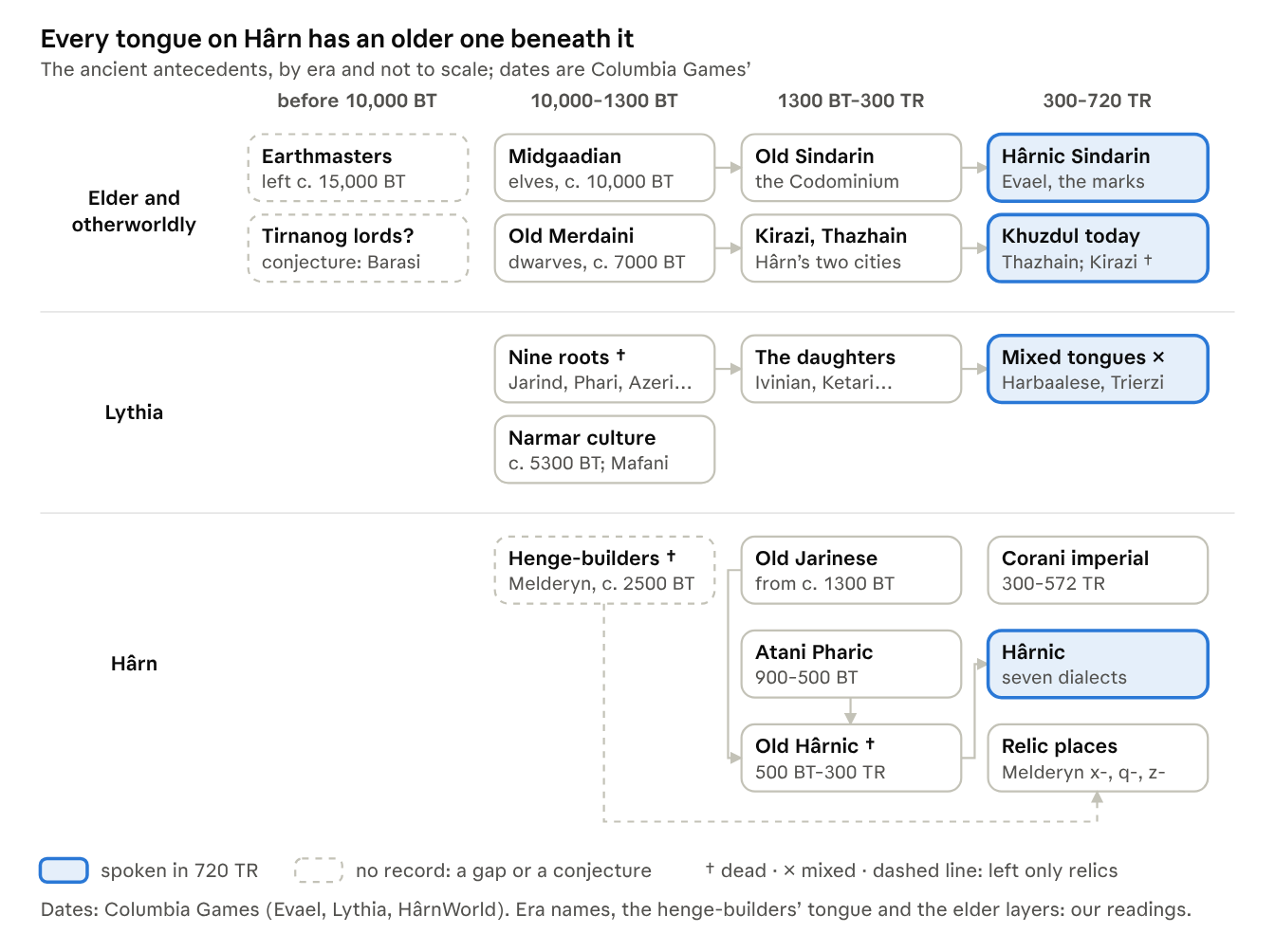
the ancient antecedent tongues · four eras, three lanes
Nothing is known of the Earthmasters’ speech, and the Lords of Tirnanog are only the mage Barasi’s theory; every later tongue on Hârn stands on a dead one, and Melderyn’s strange placenames are all that is left of the oldest human speech there.
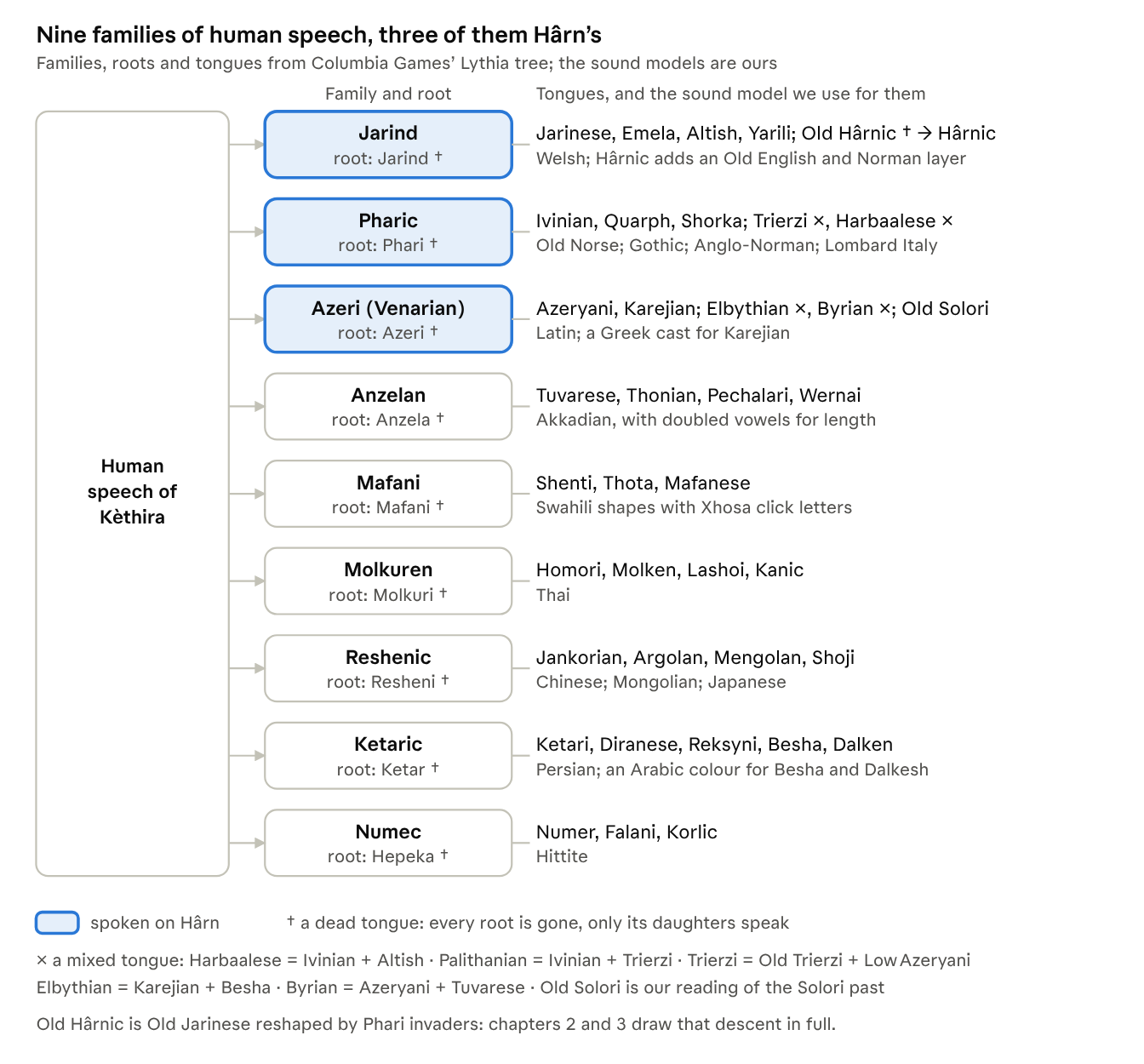
the nine families of human speech · roots, daughters and mixed tongues
The three families that reached Hârn are highlighted; the other six reach it only through ports, slaves and trade.
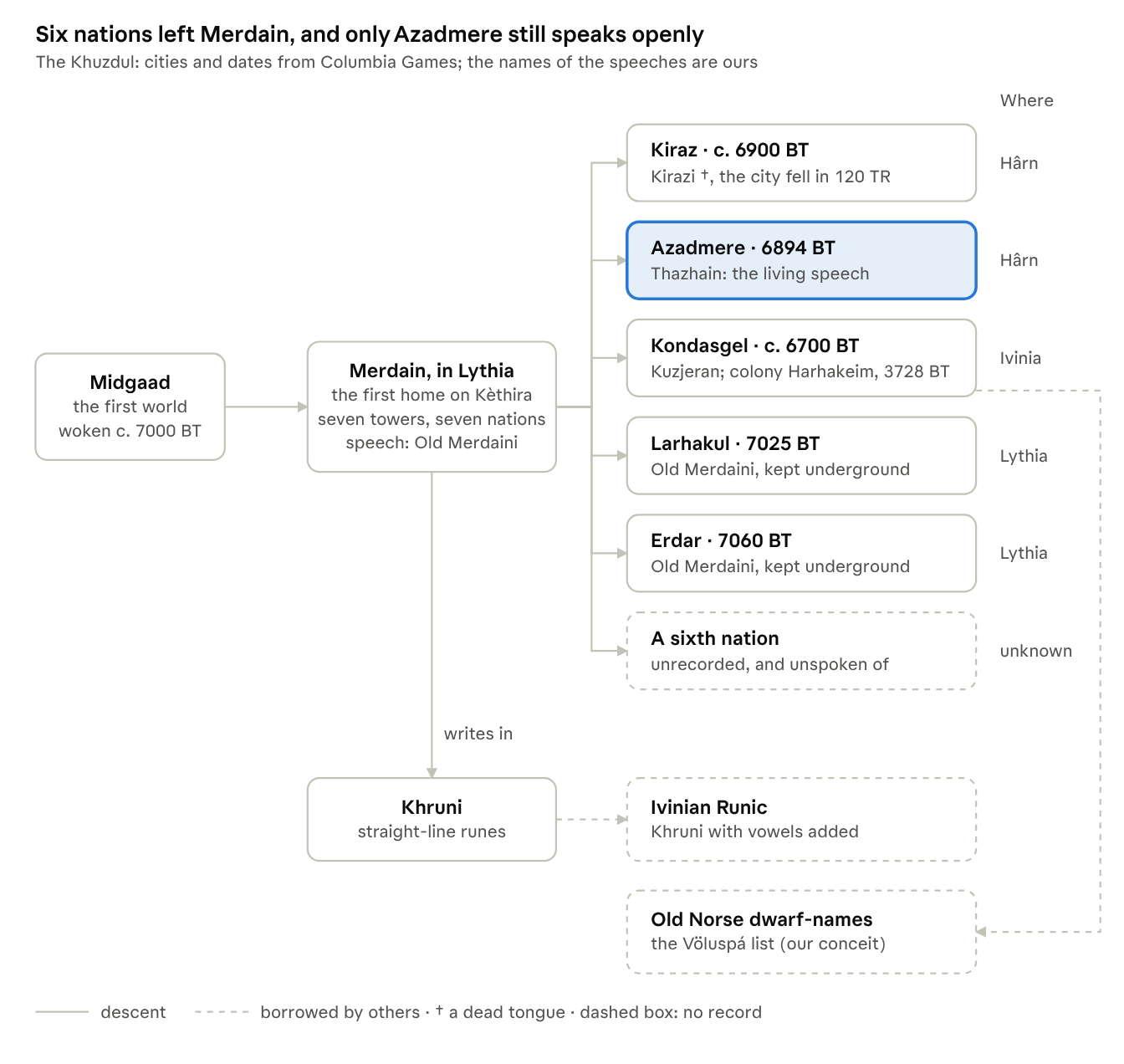
the Khuzdul nations from Merdain · cities, dates, speeches and scripts
Of the Khuzan cities only Azadmere still speaks openly to the world; Kiraz is dead, the Lythian cities hide underground, and one nation left no record at all.
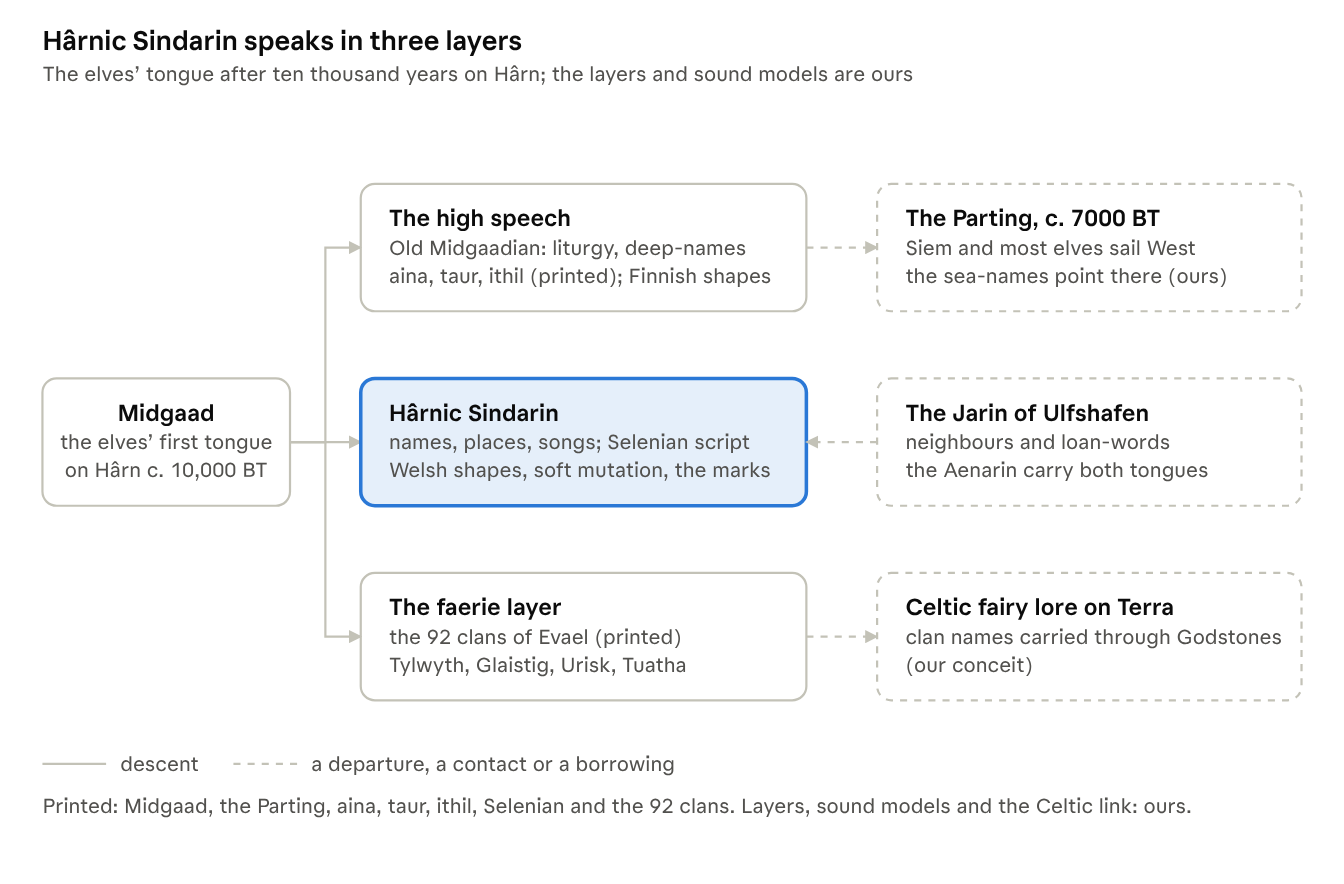
the three layers of Hârnic Sindarin · with its departures and contacts
The everyday tongue sits between a liturgical high speech and a layer of clan names from faerie lore, and only the everyday tongue still changes.